
If you’re selling a home in Cleburne, Burleson, Godley, Joshua, or elsewhere in North Texas, one of the first documents you may be asked to complete is a Seller’s Disclosure Notice.
For many residential sales in Texas, disclosure isn’t simply a courtesy—it is required by Texas law. The bigger issue for sellers, though, is understanding what needs to be disclosed, what doesn’t, and why trying to minimize a known problem can create a much bigger problem later.
Texas Property Code §5.008 establishes disclosure requirements for many sales of previously occupied single-family residences. There are also statutory exceptions, so sellers should not assume the requirement applies—or does not apply—without reviewing their specific situation.
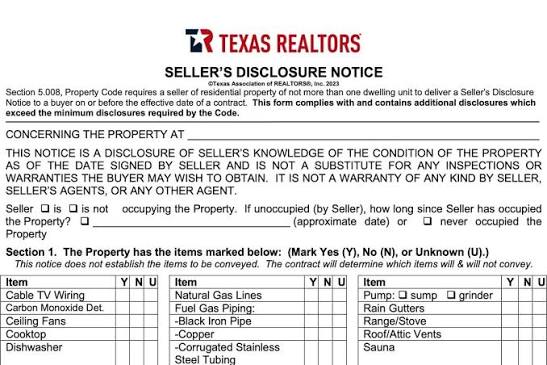
What Is a Texas Seller’s Disclosure?
The Seller’s Disclosure Notice gives a buyer information about the property based primarily on the seller’s knowledge.
It is not a warranty that the property is perfect, and sellers generally are not expected to become home inspectors.
Instead, the seller is answering questions about the property and disclosing known conditions.
That distinction matters.
If you genuinely do not know something, that is different from knowing about a condition and failing to disclose it.
What Types of Things Are Disclosed?
Depending on the applicable disclosure form and property, sellers may be asked about items such as:
| Property Area | Examples |
|---|---|
| Structural components | Foundation, roof, walls, ceilings |
| Mechanical systems | HVAC, electrical, plumbing |
| Water/sewer | Public water, well, septic |
| Property conditions | Previous water penetration or flooding |
| Environmental issues | Certain environmental conditions or remediation |
| Improvements | Additions or modifications |
| Legal/property matters | Easements, lawsuits, boundary issues, or other applicable matters |
The form should be read carefully rather than treated as another stack of paperwork to sign.
Do I Have to Disclose an Old Problem That Was Repaired?
This is where sellers frequently get nervous.
Imagine that several years ago you had a plumbing leak. The leak was professionally repaired, the damaged materials were replaced, and there has been no recurrence.
A seller may think:
“It’s fixed, so why bring it up?”
But if the disclosure asks about a previous condition, the fact that it was repaired does not necessarily make the history irrelevant.
In practice, documentation can help.
If you have invoices, warranties, engineering reports, foundation documents, roof receipts, plumbing invoices, or remediation paperwork, gather them before the property is listed.
The objective isn't to scare a buyer. It is to give the buyer accurate information and documentation showing what happened and what was done.
What About Mold Remediation?
Texas real estate forms have become more explicit on this subject.
TREC’s 2025 contract revisions added language addressing Texas requirements concerning certain mold remediation certificates issued during the preceding five years.
If your property has had professional mold remediation, tell your agent early so the appropriate documents and disclosure requirements can be reviewed.
Are There Exceptions to the Seller’s Disclosure Requirement?
Yes.
Texas law contains exceptions for certain transactions. That is why statements such as “every seller has to complete one” are too broad.
Certain transfers involving estates, foreclosures, fiduciaries, family members, new construction, and other circumstances may be treated differently under the statute.
Your agent can help identify the issue, but questions about whether a particular statutory disclosure obligation applies to you may require advice from a Texas real estate attorney.
Can a Seller Just Write “Unknown”?
“Unknown” should mean exactly that.
It should not be used as a convenient substitute for an uncomfortable answer.
If you know that the roof leaked, the foundation was repaired, or water entered the house, pretending you have no knowledge can create a far larger issue than simply explaining what happened.
A well-documented repair can actually give a buyer confidence.
An undisclosed problem discovered later tends to do the opposite.
What Should I Do Before Listing My North Texas Home?
Before your listing goes live, spend some time assembling the property's history.
Look for:
- repair invoices and transferable warranties;
- roof replacement documentation;
- HVAC service or replacement records;
- foundation reports;
- plumbing repairs;
- septic or well records where applicable;
- insurance-related repair documentation;
- permits or records for significant improvements; and
- surveys and other property documents.
This is particularly useful in Johnson County and surrounding areas, where our inventory includes everything from newer subdivision homes to older Cleburne properties, acreage, septic systems, wells, workshops, barns, and rural improvements.
The more unusual the property, the more important it becomes to understand exactly what is being sold.
Disclosure Is Only One Part of Preparing to Sell
A strong listing strategy starts before photographs are taken.
Pricing, condition, disclosures, documentation, repairs, staging, and marketing all affect how confidently a buyer views the property.
If you're considering selling in Johnson County or the surrounding North Texas area, Texan Heritage Realty Group can walk through the property with you, discuss what should be addressed before listing, and prepare a pricing and marketing strategy.
Request a home valuation from Texan Heritage Realty Group
Frequently Asked Questions
Do I have to disclose a foundation repair in Texas?
If the applicable disclosure asks about the condition or prior repair and you have knowledge of it, it should be answered accurately. Having engineering reports, repair invoices, and transferable warranty information can be especially valuable to a future buyer.
Do I have to disclose a previous roof leak?
Do not assume that repairing a leak automatically makes its history irrelevant. Read the disclosure question carefully and answer based on your actual knowledge.
Does the seller’s disclosure replace a home inspection?
No. A disclosure represents information from the seller; an inspection is an independent evaluation performed for the buyer. Buyers should still conduct appropriate due diligence.
Can my real estate agent fill out my disclosure for me?
The information is the seller's representation about the property. Your agent can explain the transaction process and the form, but the seller should provide the factual answers concerning the seller's knowledge.
What happens if I discover something after completing the disclosure?
Tell your agent promptly. A disclosure may need to be updated or additional information may need to be provided depending on the circumstances.
Should I disclose something even if I'm unsure whether it's important?
Bring it to your agent's attention rather than making that judgment alone. If it involves a legal disclosure question, an attorney may need to advise you.
Thinking About Selling?
The best time to identify potential disclosure, repair, pricing, or presentation issues is before your home hits the market, not after you're under contract.
Texan Heritage Realty Group helps homeowners throughout Johnson County and the greater North Texas area prepare strategically for the market.
Talk with Texan Heritage Realty Group about selling your home
About Jason Cech
Jason Cech is a Broker Associate with Fathom Realty and team leader of Texan Heritage Realty Group, serving Johnson County and communities throughout North Texas. Jason has approximately a decade of real estate experience and has personally closed more than 550 transactions. Texan Heritage Realty Group provides buyer and seller representation with an emphasis on local knowledge, communication, negotiation, and hands-on transaction management.
Integrity. Tradition. Excellence.
Texan Heritage Realty Group is affiliated with Fathom Realty. Information in this article is provided for general educational purposes and is not legal, tax, lending, inspection, engineering, or other professional advice. Real estate contracts and individual circumstances vary. Consumers should consult the appropriate licensed professional regarding their specific situation. Texas law requires real estate license holders to provide certain notices and disclosures. Equal Housing Opportunity.