Why do you need mortgage pre-approval before touring homes in North Texas?

In North Texas, getting pre-approved before you tour homes is the single most important thing you can do to protect your time, your money, and your chances of landing the right house. Fort Worth's market is more balanced in 2026 than it was a few years ago, but homes in attractive price ranges still receive multiple offers, and listing agents routinely set aside offers that don't include a current lender pre-approval letter.

I always tell my clients this before we ever schedule a single showing: the pre-approval isn't paperwork for paperwork's sake. It's the foundation of your entire offer strategy.

What the 2026 Fort Worth Market Actually Looks Like

If you've been watching headlines, you know North Texas has cooled from its pandemic-era intensity. That's true. But "cooled" doesn't mean "easy."

According to the Greater Fort Worth Association of REALTORS® (GFWAR) June 2026 Housing Report, the year-to-date median home price in Fort Worth through the first half of 2026 was $333,068, with the June 2026 median sitting at $335,975, down just 0.3% from June 2025. Tarrant County's year-to-date median was $350,528, and Denton County ran higher at around $434,748. Prices vary meaningfully depending on where you're shopping.

A Fort Worth Report story from July 2026 summarizing the same GFWAR data noted that Q2 2026 saw 1,067 homes sold in June alone, up 5.2% year over year, even as prices softened slightly. That's not a slow market. That's a market with more options for buyers, and still enough demand that being unprepared costs you.

Mid-2026 estimates from Zillow (updated through June 30, 2026) put Fort Worth's median days to pending at around 28 days, with about 21% of homes still closing above list price. Redfin's August 2026 snapshot characterizes Fort Worth as "somewhat competitive," with homes averaging about 2 offers and selling in roughly 46 days. Those two sources use different datasets, so treat them as context rather than definitive figures, but the direction is clear: typical Fort Worth homes go under contract in about one to two months, and multiple offers remain common in well-priced ranges.

The bottom line: you have more negotiating room than buyers had in 2021 or 2022, but you still need to be ready to move when the right home appears.

Area YTD Median Price (Jan–Jun 2026) Source
Fort Worth $333,068 GFWAR June 2026 Report
Tarrant County $350,528 GFWAR June 2026 Report
Denton County $434,748 GFWAR June 2026 Report

Those price differences matter more than most buyers realize. If you're pre-approved based on a rough estimate of what you "think" you can afford, you may be touring homes in Denton County when your budget actually fits Fort Worth or Burleson. Pre-approval gives you a real number, not a guess. If you're still working through what those numbers mean for your situation, my post on how much house you can really afford in North Texas is a good place to start.

Pre-Qualification vs. Pre-Approval: The Difference That Wins (or Loses) Deals

These two terms get used interchangeably, but they are not the same thing, and sellers in North Texas know the difference.

Pre-qualification is informal. A lender takes your self-reported income, debts, and assets and gives you a ballpark number. No verification, no credit pull (or only a soft pull). It takes fifteen minutes and means almost nothing to a listing agent reviewing competing offers.

Pre-approval is a conditional commitment. The lender has pulled your credit, verified your income documents (W-2s, tax returns, pay stubs), reviewed your assets, and run your file through underwriting guidelines. You get a letter with a specific loan amount. That letter tells the seller's agent: this buyer has been vetted.

According to NAR's 2024 Profile of Home Buyers and Sellers, 4% of successful homebuyers had at least one mortgage application rejected before ultimately closing, with debt-to-income ratio problems cited in 40% of those cases and low credit scores in 23%. Pre-approval is how you find those problems before you're under contract and have already paid for inspections.

In a market where homes can go under contract in under a month, discovering a financing issue after you've written an offer is an expensive problem. You could lose your option fee, and depending on contract timing, potentially your earnest money too. Pre-approval shifts that risk to the beginning of the process, when the stakes are zero.

How Pre-Approval Fits the Texas Homebuying Process

Texas has a specific transaction sequence that makes pre-approval even more important than in some other states, and it's worth understanding before you start touring.

The TREC Contract and Buyer Approval Deadline

When you write an offer in Texas using the standard TREC One to Four Family Residential Contract, buyers using financing typically attach the Third Party Financing Addendum. That addendum sets a "Buyer Approval" deadline, a specific date by which you must obtain full loan approval. If you're starting the pre-approval process after you go under contract, you're already behind. Buyers who come in pre-approved have a much easier time meeting that deadline and are far less likely to need extensions that can frustrate sellers or put the contract at risk.

The Seller's Disclosure and Why Speed Matters

Under Texas Property Code § 5.008, sellers of most previously occupied single-family homes must provide a written Seller's Disclosure Notice detailing known material facts and property condition. As of July 1, 2026, TREC has mandatory updated forms in effect, including a revised Seller's Disclosure Notice and a new Water Notice (TREC No. 61-0). Always confirm the latest required forms directly with TREC or your agent.

That disclosure often reveals things worth knowing: foundation history, prior flooding, roof age, mechanical systems. A pre-approved buyer can review that disclosure and quickly ask their lender whether any issues would affect underwriting. A buyer who hasn't started the loan process yet has to pause, figure out financing, and then circle back. In a market where a well-priced home in Cleburne, Burleson, or Joshua can attract multiple buyers, that delay can cost you the house.

The Title Company's Role in Your Closing Timeline

Texas is a title company closing state. Your title company acts as escrow agent, holds your earnest money, orders the title commitment, coordinates with your lender to prepare the Closing Disclosure and loan documents, conducts the signing, and records the deed with the county clerk (Tarrant County Clerk, in most Fort Worth transactions).

Here's the key: the title company cannot finalize the closing until the lender delivers clear-to-close instructions. Pre-approval shortens that path because a significant portion of the underwriting work is done before you ever write an offer. Buyers who walk in fully pre-approved tend to have smoother, faster closings. That matters to sellers, and it matters to you.

For a broader look at what the local buying process involves in Tarrant and Johnson Counties, my guide on buying a home in Johnson and Tarrant County in 2026 walks through the full sequence.

What Listing Agents in North Texas Actually Expect

Texas law doesn't require you to attach a pre-approval letter to an offer. But in practice, listing agents across Fort Worth, Weatherford, Aledo, and the surrounding communities expect one. In competitive price ranges, offers without a current lender letter are often set aside in favor of similarly priced offers from pre-approved buyers. I've seen it happen. It's not a technicality. It's a real competitive disadvantage.

Your specific situation, your price range, your target neighborhoods, and your timeline all shape how much this matters. That's exactly the kind of question I walk buyers through before we ever schedule a showing.


If you've found this helpful, I'd appreciate you taking a moment to share your experience. You can read what other buyers and sellers have said on Google, Zillow, or Realtor.com.

Frequently Asked Questions

Do I really need a mortgage pre-approval before I start touring homes in Fort Worth?

Yes, and not just as a formality. In Fort Worth's 2026 market, homes in attractive price ranges still receive multiple offers and go under contract in weeks. Listing agents routinely expect a current pre-approval letter with any serious offer, and touring without one means you're not actually ready to buy, even if you find the right home tomorrow.

What's the difference between pre-qualification and pre-approval when buying a house in Texas?

Pre-qualification is an informal estimate based on self-reported information and carries little weight with sellers. Pre-approval involves verified income documents, a credit pull, and a conditional commitment from the lender for a specific loan amount. In North Texas, sellers and their agents treat full pre-approval as significantly stronger evidence that a buyer can actually close.

Will a seller in Fort Worth even look at my offer if I don't include a pre-approval letter?

They might glance at it, but in competitive price ranges they probably won't take it seriously. North Texas listing agents commonly require or strongly prefer a current lender pre-approval letter to consider an offer. An offer at the same price from a pre-approved buyer will almost always be chosen over one without documentation of financing.

How long does a pre-approval letter stay valid in North Texas before I need to update it?

Most lenders issue pre-approval letters that are valid for 60 to 90 days, though this varies by lender and loan type. If your search extends beyond that window, you'll need to refresh it, which typically means updated pay stubs and a credit review. Confirm the specific expiration with your lender, and don't let it lapse while you're actively touring.

If my pre-approval is denied, can I still buy a home in North Texas, and what should I fix first?

A denial is not the end of the road. According to NAR's 2024 Profile of Home Buyers and Sellers, the most common reasons for rejection are debt-to-income ratio issues (40%), low credit scores (23%), unverifiable income (12%), and insufficient reserves (12%). Each of those has a path forward. A good lender will tell you exactly what to address, and the earlier you find out, the more time you have to fix it before you're under contract on a home you love.

How fast do homes sell in Fort Worth right now, and how does pre-approval help me move quickly?

As of mid-2026, estimates from national portals suggest Fort Worth homes go pending in roughly 28 to 46 days depending on the data source, with some well-priced homes moving faster. Pre-approval means that when you find the right home, you can write a credible offer the same day, rather than scrambling to start the loan process after the fact.


Pre-approval isn't just a box to check. It's the step that makes every other step in the North Texas homebuying process faster, cleaner, and more competitive. If you're ready to get started, or just want to understand exactly what a lender will look at before you call one, reach out to me directly and I'll walk you through it.

About Jason Cech

Jason Cech is the Owner and Broker Associate of Texan Heritage Realty Group in Cleburne, Texas, with over 9 years of real estate experience helping families buy and sell across Johnson County, Fort Worth, and North Texas. A DFW Real Producers Top 500 Agent and multi-year top producer, he leads his team with a client-first approach built on integrity, tradition, and excellence.

Fathom Realty · 817-776-8319

Equal Housing Opportunity. Jason Cech, Broker Associate, Fathom Realty, licensed by the Texas Real Estate Commission (TREC). This article is general information only and is not legal, tax, or financial advice. Confirm your specific situation with your attorney, tax advisor, lender, or closing officer. Broker fees and commissions are fully negotiable and not set by law. TREC: Information About Brokerage Services | TREC: Consumer Protection Notice.

Sept. 16, 2026

Luxury Real Estate in Johnson County for Buyers

Luxury Real Estate in Johnson County for Buyers

By Jason Cech·September 7, 2026

Johnson County offers a distinct luxury tier built on acreage, privacy, and custom estate properties rather than dense urban prestige. Buyers can find multi-million-dollar ranch and equestrian holdings alongside high-spec suburban builds, often at lower price points than comparable inner-DFW luxury enclaves like Highland Park or Southlake.

What does the luxury real estate market in Johnson County actually look like for buyers in 2026?

Johnson County's luxury market is built on land, privacy, and custom construction rather than urban prestige or zip-code cachet. Buyers here can access everything from high-spec suburban builds in communities like Burleson and Cleburne to investment-grade ranch and equestrian estates in Godley, with individual listings reaching nearly $19 million for large contiguous tracts. That range makes Johnson County one of the most distinctive luxury plays in the broader North Texas ecosystem.

Key Takeaways

  • The most recent Johnson County data available (December 2025, via Redfin) shows a county-wide median sale price of $340,000 and an average of 86 days on market, down from 102 days the prior year.
  • A 2026 listing snapshot on Zillow confirmed a ~352-acre estate tract in Godley asking $18,990,000, showing Johnson County participates in the true upper-tier North Texas land market.
  • In Q1 2026, the North Texas luxury segment between $1M and $2M faced the most pricing pressure due to rate sensitivity and rising inventory, while the $5M-and-up tier showed constrained supply and stronger outcomes.
  • Johnson County's rural and exurban character gives luxury buyers access to multi-acre tracts, equestrian infrastructure, and custom homes at a lower nominal price than established inner-DFW enclaves like Highland Park or Southlake.
  • Higher-spec inventory in Johnson County historically moves more slowly than inner-metro luxury, making negotiation posture and pricing strategy especially important for both buyers and sellers.

How does Johnson County's luxury market compare to the rest of North Texas?

The honest answer is that Johnson County plays a different game than Highland Park or Southlake, and that's exactly the point for a lot of buyers I work with.

The most recent county-wide data, from Rocket Homes for July 2025, shows a median list price of $367,090 with a median price per square foot of $180 and 1,597 active listings. The December 2025 Redfin snapshot puts the median sale price at $340,000, down 5.1% year-over-year, with an average of 86 days on market. Those are county-wide figures across all price ranges, not a luxury-only read, and they reflect 2025 conditions. As of September 2026, they remain the most recent published figures available.

Now compare that to the inner-DFW luxury core. A Q1 2026 North Texas luxury market analysis noted that Highland Park posted roughly 65% growth in median price with declining days on market, University Park showed about 9% growth with stable conditions, and Southlake saw approximately 4% price growth alongside a 25% improvement in absorption. Those markets are operating in a completely different price band, often well above $2 million as a starting point.

Johnson County's advantage isn't prestige-by-address. It's land, privacy, and a lower cost of entry into a genuinely upscale lifestyle. That's a real value proposition for buyers who want acreage or equestrian capability without paying Westlake prices.

For a broader look at buying across the county line, my post on Buying a Home in Johnson & Tarrant County in 2026 covers the general market dynamics in depth. And if you're weighing Johnson County against an urban luxury option, the Fort Worth Downtown Luxury Real Estate: 2026 Buyer Guide gives you a direct comparison point.

How the North Texas luxury tiers behave differently

The Q1 2026 regional analysis breaks the luxury segment into three tiers that behave very differently from each other, and understanding which tier you're shopping in changes your strategy entirely.

Price Tier Market Conditions (Q1 2026, North Texas) Buyer Implications
$1M to $2M Most pressure: rate sensitivity, rising inventory More negotiating room; pricing scrutiny matters most
$2M to $5M Most competitive; increased scrutiny and negotiation Expect multiple interested parties on well-positioned properties
$5M and up Constrained supply; highly targeted buyers; strong pricing Limited inventory; sellers hold more leverage on price

Most Johnson County luxury transactions, outside of the large estate and ranch holdings, fall in or near that $1M to $2M tier. That means buyers here have more room to negotiate than in the inner-metro luxury core, but it also means pricing a property correctly matters enormously for sellers.

What kinds of properties define Johnson County's luxury segment?

This is where Johnson County gets genuinely interesting, because the inventory here doesn't look like what most people picture when they hear "luxury real estate."

Estate and ranch properties

The clearest example of Johnson County's upper tier: a 2026 listing snapshot on Zillow confirmed a 351.91-acre tract in Godley, Texas, carrying an asking price of $18,990,000. That's not an outlier in terms of what the county can host. Johnson County's rural and exurban character supports large contiguous acreage, gated entries, long private drives, and ranch infrastructure that simply doesn't exist in denser suburban markets.

Buyers in this category are typically looking at properties with equestrian facilities, working ranch infrastructure, or long-term development and legacy potential. It's a fundamentally different asset class than a high-end home in a gated subdivision, and it requires a different due diligence process. Working with a reputable title company for a thorough title search, easement review, and closing coordination is especially important on large-acreage tracts where mineral rights, water rights, and access easements can all be in play.

If you're specifically looking at Godley, my post on New Construction in Godley TX: What Buyers Need to Know covers the development landscape there in more detail.

Custom and high-spec suburban builds

Not every luxury buyer in Johnson County is shopping for acreage. There's also a meaningful inventory of custom-built homes in communities across Burleson, Cleburne, and Joshua that offer high-end finishes, open floor plans, indoor-outdoor living design, and larger lots than you'd find inside Fort Worth city limits, at prices that still undercut the inner-metro luxury market.

A March 2025 Redfin luxury-segment snapshot showed roughly 126 higher-spec listings in the county with a median listing price near $370,000 and typical days on market around 91 days. That platform's definition of "luxury" skews lower than a true high-end threshold for North Texas, but the data confirms one important pattern: higher-spec inventory in Johnson County moves more slowly than comparable properties in inner-metro luxury neighborhoods. For a buyer, that's useful information. For a seller, it means pricing precision matters from day one.

The commute and lifestyle equation

One thing I hear consistently from buyers considering Johnson County is the question of commute. The county sits south and southwest of Fort Worth, with access to major corridors that connect to Fort Worth employment centers. For buyers who work remotely or have flexible schedules, that tradeoff disappears entirely. For buyers who need to be in Fort Worth regularly, the commute is real but manageable, and many tell me the privacy and land access more than compensate.

The lifestyle proposition here is land, quiet, and space. That's a specific kind of luxury, and it's one that DFW's broader million-dollar sales data shows is in growing demand across the region.

How should a buyer approach negotiating on a high-end Johnson County property?

The data tells you something useful here. With higher-spec properties in Johnson County averaging around 86 to 91 days on market as of the most recent available figures, you're generally not walking into a bidding war the way you might in Highland Park or Southlake. That doesn't mean sellers are desperate, but it does mean there's usually room for a well-structured offer.

A few things I walk my buyers through when we're approaching a high-end property in this market:

  • Understand the seller's timeline. Estate and ranch properties often have specific motivations, whether that's a family transition, a development timeline, or an estate situation. Knowing what the seller needs beyond price can create negotiating room that pure price-focus misses.
  • Get your financing squared away before you tour. Jumbo loan underwriting is a different process than a conventional mortgage, and lenders vary significantly on how they handle large-acreage properties. A pre-approval that doesn't account for the specific property type can fall apart late in the process.
  • Inspect thoroughly. On custom homes and estate properties, inspection findings are almost guaranteed to surface. In my experience working across Johnson County, not every finding is a deal-breaker, and everything is negotiable. The key is having an agent who knows how to read what's material versus what's cosmetic.
  • Verify title early. On large tracts especially, the title company's search and examination process can surface easements, mineral rights reservations, or access issues that affect value and use. Build enough time into your option period to get those answers.

Every situation is different, and the only way to know what the right offer looks like is to run the numbers and context with someone who knows this specific market. That's exactly the kind of conversation I have with buyers before we ever put pen to paper.

Before you start touring properties, I'd also encourage you to read what I've put together on the best areas to buy in Johnson and Tarrant County based on how you live, which helps buyers match their lifestyle priorities to the right communities before they get deep into the search.

If you're ready to see what's available or want a personalized look at the upper-tier inventory in Johnson County right now, start your home search here or reach out directly to talk through your priorities.

I'd also invite you to read what past clients have said about working with our team. You can find reviews on Google, Zillow, and Realtor.com.

FAQ: Luxury Real Estate in Johnson County

What price point counts as "luxury" in Johnson County compared to central Fort Worth or Dallas?

In Johnson County, the practical luxury threshold starts well below the inner-DFW luxury floor. The county's most recent median sale price (December 2025, per Redfin) was $340,000 county-wide, so homes in the $600K to $1M range already represent the upper tier of the local market. True high-end properties, especially acreage and estate holdings, can reach into the multi-millions. By contrast, established luxury enclaves like Highland Park or Westlake start their meaningful luxury inventory well above $2 million, making Johnson County a lower nominal entry point for buyers who want upscale features and land.

Are there $1M-plus ranch and equestrian properties in Johnson County, and what do they typically offer?

Yes, and they can reach well above $1 million. A 2026 listing snapshot confirmed a ~352-acre estate tract in Godley, TX, listed at $18,990,000, according to Zillow. Properties at this level typically include large contiguous acreage, equestrian or ranch infrastructure, gated access, and long-term development or legacy potential. Buyers considering large-acreage tracts should plan for additional due diligence around mineral rights, water rights, and easements, all handled through a thorough title company review before closing.

How do days on market compare for higher-end homes in Johnson County versus the broader DFW luxury market?

Higher-spec properties in Johnson County have historically taken longer to sell than inner-metro luxury. The most recent available data shows county-wide average days on market of about 86 days (December 2025, Redfin), with the luxury-tagged segment running around 91 days as of early 2025. In contrast, submarkets like Highland Park and Southlake showed faster absorption in Q1 2026. For buyers, slower absorption means more negotiating room; for sellers, it reinforces the importance of accurate pricing from the start.

Is Johnson County still a value play for luxury buyers compared to more expensive inner-metro neighborhoods?

For buyers who prioritize land, privacy, and custom construction over urban proximity, Johnson County remains a strong value relative to inner-DFW luxury enclaves. You can access larger lots, more acreage, and newer builds at price points that are meaningfully lower than comparable square footage in Southlake, Westlake, or Highland Park. The tradeoff is commute distance and a different kind of lifestyle, which is exactly the right fit for many buyers and the wrong fit for others. Your specific priorities determine whether the value equation works for you.

How has the Johnson County market shifted since 2024, and what does that mean for upper-tier buyers in 2026?

The county's median sale price dipped 5.1% year-over-year to $340,000 in December 2025, per Redfin, while days on market improved from 102 to 86 days, suggesting the market absorbed inventory somewhat faster even as prices softened slightly. For upper-tier buyers in 2026, that backdrop means there is likely more room to negotiate than in the peak years, particularly in the $1M to $2M tier where the regional luxury analysis flagged the most pricing pressure. Making decisions based on current local data, not national headlines, is the right approach here.
About Jason Cech

Jason Cech is the Owner and Broker Associate of Texan Heritage Realty Group in Cleburne, Texas, with over 9 years of real estate experience helping families buy and sell across Johnson County, Fort Worth, and North Texas. A DFW Real Producers Top 500 Agent and multi-year top producer, he leads his team with a client-first approach built on integrity, tradition, and excellence.

Texan Heritage Realty Group powered by Fathom Realty · 817-776-8319

Sept. 14, 2026

What the 2026 Cleburne TX Market Shows for Investors

Cleburne offers investors a balanced, affordable entry point into the DFW market, with median sale prices around $285,000, well below the metro's $390,000 median, roughly 3.9 months of supply, and a mix of high-equity, long-held homes and a smaller distressed segment worth targeting.


Is Cleburne, TX a good place to invest in real estate in 2026?

Cleburne is a balanced, affordable submarket within the broader DFW economy, with median sale prices around $285,000, roughly $105,000 below the metro-wide median as of Q3 2026. The market is neither overheated nor stagnant: days on market run in the mid-50s to mid-70s, inventory sits near 3.9 months of supply, and year-over-year price movement is flat to slightly down. That combination creates a window for patient, value-oriented investors who want DFW access without metro-core pricing.

Key Takeaways

  • The median sale price in Cleburne over the three months ending July 2026 was $285,000, down 1.6% year-over-year, according to Redfin.
  • The DFW metro-wide median sale price reached $390,000 in Q3 2026, putting Cleburne roughly $105,000 below the regional benchmark.
  • Active inventory in Cleburne stood at about 256 listings with 3.9 months of supply as of late August 2026, indicating a balanced-to-slightly-buyer-leaning market.
  • About 53% of Cleburne sales closed under list price in early 2026, while roughly 20% closed over asking, negotiation strategy matters here.
  • A mid-2025 snapshot identified over 10,000 high-equity properties in Cleburne, alongside a smaller distressed segment, pointing to real opportunities across multiple investment strategies.

What does Cleburne's 2026 market actually look like for investors?

The short version: Cleburne is in a plateau, not a freefall. Prices have softened slightly from their 2022–2024 peak, but the five-year trend still shows meaningful cumulative appreciation. Redfin's data for the three months ending July 2026 puts the median sale price at $285,000, down 1.6% year-over-year. At the same time, the median price per square foot rose 3.2% to $161 over that same window, which tells me the underlying value of well-priced homes is holding up even as headline numbers ease.

Zoom out a little and the picture gets clearer. A DFW market analytics source tracking MLS data shows Cleburne's quarterly median rising from $261,085 in Q1 2022 to a peak near $289,945 in Q1 2025, then settling to roughly $282,000 in Q3 2026. That's not a crash. That's a market finding its floor after a run-up, which is exactly when patient investors do their best work.

Over the 12 months prior to late August 2026, the same source reports 792 homes sold in Cleburne, a median sale price of $286,935, and a median of 56 days on market. With about 256 active listings and 104 under contract, the absorption picture points to a balanced-to-slightly-buyer-leaning environment, not the frenzied seller's market of 2021, but not a buyer's fire sale either.

Zillow's data through February 2026 adds a useful detail: roughly 53.2% of sales closed under list price, while 19.7% closed over asking. That split tells you there's real negotiating room in most transactions, but competitive segments still exist. Price your offer thoughtfully, and you can move without overpaying.

For context, Houzeo's March 2026 market summary describes Cleburne as an "equilibrium" market, with a median sale price of $281,297, homes taking about 76 days to sell, and a 4.6-month supply of inventory. Properties sold at approximately 100.05% of asking price on average. That's about as balanced as a market gets.

How does Cleburne stack up against the rest of DFW?

This is where Cleburne's investment case gets compelling. The DFW metro-wide median sale price hit $390,000 in Q3 2026, according to a regional market report aggregating 60 cities. Cleburne's median sits roughly $105,000 below that benchmark. Lower entry prices mean lower capital requirements, potentially higher rent-to-price ratios, and a larger pool of cost-conscious buyers if you're planning an exit.

The Fort Worth growth story is real, and Cleburne benefits from it as a satellite submarket. Buyers who can't afford Fort Worth proper or suburban cities closer to the core are looking south, and Cleburne is where many of them land. That demand pressure doesn't disappear just because headline prices have softened slightly.

A statewide housing data portal's FY2026 figures reinforce the affordability angle, listing Cleburne's median home value at $221,100 with median rent around $1,322, both below Johnson County and Texas statewide medians. A separate 2025 figure from Realtor.com put median rent closer to $1,660. The spread between sources reflects different methodologies and time periods, but both figures point to a workforce-housing market where rents are solid enough to support buy-and-hold returns without requiring luxury-tier pricing.

Metric Cleburne (2026) DFW Metro (Q3 2026)
Median Sale Price ~$285,000 ~$390,000
Median Price Per Sq Ft $161 N/A (metro-wide varies)
Median Days on Market 56 (trailing 12 months) ~148 (new homes, June 2026)
Months of Supply ~3.9 Varies by submarket
% Sales Over List Price ~19.7% (early 2026) Varies by submarket

Sources: Redfin, Zillow, Houzeo. DFW metro figures from a regional market report aggregating 60 cities. Figures reflect the most recent available data as of September 2026.

What investment strategies make sense in Cleburne right now?

Buy-and-hold for rental income

Cleburne's affordability relative to DFW makes buy-and-hold the most straightforward angle. Lower purchase prices combined with rents in the $1,300–$1,660 range (depending on the source and year) can produce cash-flow math that's harder to achieve in closer-in suburbs. The workforce-housing segment here is durable, these are long-term renters, not speculative short-term tenants.

I work with investors in this market regularly, and the conversations almost always come back to the same point: Cleburne gives you DFW employment access at a price point that still pencils. That's not true everywhere in this metro.

Targeting high-equity and distressed properties

A property data platform's snapshot from June 2025 (the most recent available data of this type) identified 10,094 properties in Cleburne with more than 50% equity, with roughly 7,213 homes fully paid off. That's a large pool of long-term owners who may be ready to sell, downsize, or relocate, often with flexibility that newer, leveraged sellers don't have.

The same report noted 386 involuntary liens on 303 properties and 29 pre-foreclosure cases as of mid-2025. That's a smaller but real distressed segment where solving a problem, clearing a lien, helping an owner avoid foreclosure, can create genuine value for both parties. These counts will have shifted by September 2026, but the structural reality of Cleburne's older, long-held housing stock persists.

According to PropertyFocus, Cleburne's mid-2025 median single-family price in this data set was $252,127, consistent with the broader picture of an affordable, accessible market.

New construction and infill

DFW housing starts fell to 41,222 units in 2025, a 12.3% drop from 46,991 in 2024, according to a January 2026 report in The Real Deal. Builders are moderating activity across the metro. In smaller cities like Cleburne, that means less competition from large-volume builders and potential openings for infill or small-scale development where the big players aren't focused.

A June 2026 report from CultureMap Dallas puts the average new-home price in the Metroplex at about $460,012, down roughly $10,000 year-over-year, with new homes averaging about 148 days on market. That's a slower pace than resale in Cleburne, and it's a reminder that new construction isn't automatically the faster path to returns right now.

If you're thinking about new construction in the broader Johnson County area, the Godley new construction guide covers what buyers and investors need to know about the process in this part of North Texas.

A note on data variability

I'll be straight with you: the numbers across sources don't always line up perfectly. A June 2026 Cleburne market overview noted median price ranges from $285,000 to $314,990 depending on the data provider, days on market ranging from 47 to 115 days, and sale-to-list ratios around 96.15%. That spread reflects differences between new and resale homes, price bands, and data methodologies.

The HAR Cleburne price trend data (using NTREIS data) shows April 2026 with an average price of $312,687 and a median sold price of $287,000 across 49 sales, consistent with the broader picture. Any investment decision should be grounded in current, local MLS data, not a single portal snapshot. That's exactly what a good local agent and a title company familiar with Johnson County properties will help you pull together before you commit.

Make decisions based on real local data, not viral headlines about a national housing crash. The Cleburne market has its own rhythm, and it doesn't always track what you're seeing in national news cycles.

If you want to see what's actually available and how deals are moving right now, start your search here or reach out to get a current market analysis for the specific price band and property type you're targeting.

I've helped investors across Cleburne, Burleson, Joshua, and the rest of Johnson County find properties that fit their strategy, and I know which corners of this market are moving and which ones are sitting. That local context is what turns a promising market overview into an actual deal.

If you're thinking about the selling side of an investment, the Cleburne seller's guide walks through what to expect when you're ready to exit.

I'd also invite you to read what past clients have said about working with my team on Google, Zillow, and Realtor.com.

Frequently Asked Questions

What are current home prices and days on market in Cleburne, TX in 2026?

The median sale price in Cleburne over the three months ending July 2026 was $285,000, with a median of 56 days on market over the trailing 12 months, according to Redfin. Other sources tracking spring 2026 data show median sold prices in the $281,000–$287,000 range, with days on market ranging from the mid-50s to mid-70s depending on the segment. Inventory sits near 3.9 months of supply as of late August 2026, putting the market in balanced-to-slightly-buyer-leaning territory.

How does Cleburne's housing affordability compare to the rest of DFW?

Cleburne's median sale prices in the upper-$200Ks sit roughly $105,000 below the DFW metro-wide median of $390,000 in Q3 2026. That gap makes Cleburne one of the more affordable entry points in the broader metro, particularly for investors targeting workforce housing or buyers priced out of closer-in suburbs. A statewide housing data portal's FY2026 figures also show Cleburne's median home value and median rent below both Johnson County and Texas statewide averages.

Are Cleburne home values going up or down, and what does that mean for investors?

Year-over-year price movement in Cleburne is flat to slightly negative in 2026, with Redfin reporting a 1.6% decline in median sale price and Zillow showing roughly a 4% drop in typical home value from the prior year. The five-year trend from 2022 to 2026 still shows meaningful cumulative appreciation, so this is a plateau, not a collapse. For investors, that means more time to perform due diligence and more negotiating room than the market offered in 2021–2022, without the risk of buying into a rapidly declining market.

How competitive is the Cleburne market, are properties still selling over asking price?

Cleburne is not a bidding-war market right now. About 53% of sales in early 2026 closed under list price, while roughly 20% closed over asking, according to Zillow data through February 2026. A March 2026 summary from Houzeo shows properties selling at approximately 100.05% of asking price on average, with a 4.6-month supply of inventory. Competitive pockets still exist, but pricing and negotiation strategy matter far more here than in peak-market years.

Is Cleburne a good place to invest in rental property compared to other North Texas cities?

Cleburne's combination of below-metro entry prices and a solid workforce-rental base makes it a credible buy-and-hold market, particularly compared to Fort Worth proper or suburban cities closer to the DFW core where purchase prices compress yields. Median rent estimates range from roughly $1,322 (FY2026 statewide housing portal) to $1,660 (Realtor.com, 2025 data), reflecting a workforce-housing segment with stable long-term occupancy potential. The best way to evaluate a specific property's return is to run current MLS comps and rental data with a local agent who knows the Johnson County market.

About Jason Cech

Jason Cech is the Owner and Broker Associate of Texan Heritage Realty Group in Cleburne, Texas, with over 9 years of real estate experience helping families buy and sell across Johnson County, Fort Worth, and North Texas. A DFW Real Producers Top 500 Agent and multi-year top producer, he leads his team with a client-first approach built on integrity, tradition, and excellence.

Fathom Realty · 817-776-8319

Equal Housing Opportunity. Jason Cech, Broker Associate, Fathom Realty, licensed by the Texas Real Estate Commission (TREC). This article is general information only and is not legal, tax, or financial advice. Verify your own numbers with your title company, tax advisor, or lender. TREC: Information About Brokerage Services | Consumer Protection Notice.

Sept. 11, 2026

Cash to Buy a House in Fort Worth: 2026 Numbers

To buy a median-priced home in Fort Worth in 2026, you need cash for at least five separate buckets: option fee, earnest money, inspections, appraisal, down payment, and closing costs. Texas programs through TDHCA can cover part of the down payment and closing costs, but several items still require your own cash regardless of assistance.


How much cash do you actually need to buy a house in Fort Worth in 2026?

Buying a median-priced home in Fort Worth in 2026 requires cash across at least five separate buckets, option fee, earnest money, inspections, appraisal, down payment, and closing costs. According to the Greater Fort Worth Association of REALTORS®, the Fort Worth median closed-sale price in June 2026 was $335,975. Your total upfront cash need depends on your loan type, what assistance you qualify for, and how the contract negotiations go, but understanding each bucket before you make an offer is the only way to avoid a surprise at the closing table.

The Five Cash Buckets Every Fort Worth Buyer Faces

Here's what I walk every buyer through before we start touring homes. Texas has a contract structure that most other states don't use, and it creates cash obligations that hit at different times, some of them non-refundable. Knowing the sequence matters as much as knowing the total.

Bucket 1: Option Fee (Due Within Days of Contract Acceptance)

Texas is one of the few states where buyers pay an option fee directly to the seller in exchange for an unrestricted right to terminate during the option period. This is spelled out in the TREC One to Four Family Residential Contract (Resale), which is the standard form used in virtually every Fort Worth resale transaction.

The option fee is typically due within a very short window after contract execution, often just a few days. It is generally non-refundable, regardless of what you find during inspections. If you close, it may be credited toward your purchase price depending on how the contract is written. If you walk away during the option period, you lose it. That's the trade-off: you're buying the right to terminate for any reason, penalty-free beyond that fee.

In the more balanced 2026 Fort Worth market, Fort Worth Report's July 2026 summary of GFWAR data described Q2 2026 as a market where increased inventory created better balance for buyers and sellers, you generally have more room to negotiate option period length and terms than buyers did in 2021. That said, the contract still sets firm deadlines, and missing them has real consequences.

Bucket 2: Earnest Money (Due to the Title Company Shortly After Contract)

Earnest money is separate from the option fee. It goes to the title company, not the seller, and is held in escrow until closing or contract termination. According to the Texas Real Estate Commission, earnest money is applied toward your funds at closing if the deal closes, or released according to the contract terms if it doesn't.

The key protection here: if you terminate correctly within the option period, your earnest money is generally refundable. If you terminate after the option period expires, you may lose it. This is why I always tell buyers to treat the option period deadline as a hard stop, not a suggestion.

Per the Texas Department of Insurance, the title company holds earnest money, receives lender funds, collects your cash to close, and records the deed. Everything flows through them. Fort Worth buyers should plan to wire earnest money to the title company within the contract-specified timeframe, typically a few days after execution.

Bucket 3: Inspections (During the Option Period, Out-of-Pocket)

Home inspections are buyer-ordered and buyer-paid, and the cost hits during the option period, before you know for certain whether the deal will close. Per Texas REALTORS®, these costs are almost always non-refundable regardless of outcome.

On a mid-$330K Fort Worth home, you might order a general inspection plus one or more specialized inspections (foundation, HVAC, roof, septic if applicable). What the Texas Seller's Disclosure reveals early in the process often shapes how much you spend here. If the disclosure shows a history of foundation movement or a roof near end of life, a buyer who plans carefully will budget for additional specialist inspections, and potentially re-inspections after repairs. That's real cash out the door before closing, and it doesn't come back if the deal falls apart.

Bucket 4: Appraisal (Lender-Required, Usually Paid Upfront or at Closing)

For financed purchases, the lender orders an appraisal and the buyer pays for it. The Consumer Financial Protection Bureau notes that appraisal fees are a standard loan cost, paid either when the appraisal is ordered or at closing depending on lender policy. Either way, it's your cash.

This is one of the items that Texas down payment assistance programs generally do not cover, which I'll address in a moment.

Bucket 5: Down Payment and Closing Costs (Due at Closing, via the Title Company)

Your down payment is whatever portion of the purchase price isn't covered by your first mortgage and any assistance programs. Your closing costs include lender charges, title-related fees, prepaids (homeowners insurance, property taxes into escrow), recording fees, and other third-party charges.

Which party pays which title and escrow items in Texas is heavily negotiable and varies by contract. The Texas Department of Insurance confirms there is no single statutory rule requiring the buyer or seller to pay specific title-related items apart from fees set by law. Your contract and your negotiations determine a lot of this, another reason why reviewing your specific closing disclosure carefully with your agent and lender matters.

Per Freddie Mac's consumer education, many conventional loans permit down payments as low as 3-5%, and FHA loans permit as little as 3.5% down, subject to loan limits and credit guidelines. You don't need 20% down to buy in Fort Worth, but you do need to understand what low-down-payment loans mean for your total cash picture, including mortgage insurance costs factored into your monthly payment.

For a deeper look at how affordability and down payment levels interact in this market, I'd recommend reading how much down payment you really need in Johnson and Tarrant County and how much house you can really afford in North Texas, both walk through the same questions buyers ask me every week.

2026 Fort Worth Market Snapshot and What It Means for Your Cash

Here's where the local numbers matter. According to GFWAR's June 2026 North Texas Housing Report, Fort Worth's median closed-sale price in June 2026 was $335,975, down 0.3% versus June 2025. The year-to-date (January through June 2026) Fort Worth median was $333,068, while the broader Tarrant County median for the same period was $350,528.

Market Area Median Sale Price (Jan–Jun 2026) June 2026 Median YOY Change
Fort Worth $333,068 $335,975 -0.3%
Tarrant County $350,528 $350,528 Flat YOY

Source: Greater Fort Worth Association of REALTORS® June 2026 North Texas Housing Report. Closed-sale medians; not listing prices.

Active listing prices run a bit higher. Realtor.com's Fort Worth market page reported a median listing price of approximately $348,000 as of late August 2026. The gap between listing and closed-sale medians reflects normal negotiation in a more balanced market.

With GFWAR's January 2026 report showing 3.2 months of inventory in Fort Worth, up slightly from 3.1 months the prior year, buyers in 2026 have more negotiating room than they did in 2020 or 2021. That affects your option terms and earnest money strategy. You're not necessarily competing in a multi-offer war on every home, which means you may be able to negotiate a longer option period and more reasonable earnest deposit. Every deal is different, but the market context matters when you're deciding how aggressive to be.

Texas Down Payment Assistance: What It Covers and What It Doesn't

The Texas Department of Housing and Community Affairs (TDHCA) offers statewide programs, including My First Texas Home and My Choice Texas Home, that can pair a first-lien mortgage with down payment and closing cost assistance for eligible buyers. As of 2025-2026, assistance is typically structured as a second lien or grant, subject to income limits, purchase price limits, and occupancy requirements.

Here's the honest picture of what assistance can and can't do for your cash position:

  • Can cover: A meaningful portion of your down payment and allowable closing costs, depending on the program and your eligibility.
  • Cannot cover: Option fee (paid to the seller), home inspections (paid directly to inspectors), and in many cases the appraisal fee depending on lender policy.
  • Still requires: You to meet credit and debt-to-income guidelines, and to bring some cash reserves depending on lender and program requirements.

TDHCA's own guidance is clear that these programs reduce but do not eliminate your cash requirement. And program funds can change mid-year, I've seen buyers lose access to a specific assistance tier because the funding round closed before they were ready to contract. Getting pre-qualified for both the primary loan and the assistance program early is not optional if you want to use these programs. It's the only way to know what you're actually working with.

Your specific cash picture depends on your income, the home's price, your loan type, and what the seller is willing to negotiate on title costs and concessions. That's the kind of analysis I run through with every buyer before we start making offers, not after.

If you want to see what other buyers across Johnson and Tarrant County are navigating in 2026, the 2026 local buyer guide covers the broader picture.

I'd love to hear what other buyers have said about working through this process, you can read reviews on Google, Zillow, and Realtor.com.

Frequently Asked Questions

How are earnest money and the option fee different in Texas, and when do I pay each?

They are two separate cash items with different recipients and different risk profiles. The option fee is paid directly to the seller within a short deadline after contract execution and gives you the unrestricted right to terminate during the option period, it is generally non-refundable. Earnest money is paid to the title company and held in escrow; if you terminate correctly within the option period, it is typically refundable. Both are required under the standard TREC residential contract, and both are due quickly after acceptance.

Do I get my earnest money back if I back out during the option period in a Texas contract?

Generally yes, if you terminate in writing within the option period and follow the contract's termination procedures. The Texas Real Estate Commission outlines how termination and earnest money release work under the standard contract. Missing the option period deadline is where buyers get into trouble, after it expires, your earnest money is at risk if you walk away. Your agent should track this deadline as a hard stop, not a soft guideline.

What's the minimum down payment for a house in Fort Worth using a Texas loan program?

Conventional loans can go as low as 3-5% down, and FHA loans permit as little as 3.5% down, per Freddie Mac's consumer guidance. TDHCA programs through My First Texas Home or My Choice Texas Home can layer assistance on top of those low-down-payment loans for eligible buyers, potentially covering a significant portion of the down payment and allowable closing costs. You still need your own cash for option fee, inspections, and appraisal regardless of the program.

What upfront costs do I pay out of pocket besides my down payment?

In a Texas transaction, plan for option fee (to the seller), earnest money (to the title company, but credited back at closing if the deal closes), home inspections (paid directly to inspectors during the option period), appraisal (paid to the lender as a loan cost), and your buyer-side closing costs. Inspections and the option fee are the items most likely to be truly out-of-pocket and non-refundable regardless of outcome. The CFPB's appraisal fee guidance and Texas REALTORS® both outline these as standard buyer costs in a financed purchase.

Can Texas down payment assistance cover my closing costs in Fort Worth, or do I still need my own cash?

TDHCA programs can cover down payment and allowable closing costs for eligible buyers, per TDHCA's homebuyer assistance page. However, they do not cover option fees, home inspections, or in many cases the appraisal, so you will still need some of your own cash regardless. Program availability and funding can also shift mid-year, which is why getting pre-qualified for both the primary loan and the assistance program early is critical.

Who chooses the title company in Fort Worth, and does it affect what I pay at closing?

The title company is agreed upon by both parties in the TREC contract, often the seller's side proposes one, but it is negotiable. Per the Texas Department of Insurance, the title company holds your earnest money, collects your cash to close, issues title insurance policies, and records the deed. Which party pays for which title policy, owner's versus lender's, is also contract-negotiable in Texas and often follows local custom rather than a statutory requirement, so your specific contract terms matter.

Know Your Number Before You Make an Offer

The 20%-down rule of thumb has nothing to do with how most Fort Worth buyers actually purchase homes in 2026. Your real cash requirement is a combination of loan type, assistance eligibility, contract terms, and what the inspections turn up, and the only way to get an accurate number is to run it with someone who knows this market and your specific situation.

Start with a free home valuation or buyer consultation at texan-heritage.com and I'll walk you through exactly what your cash picture looks like before you make your first offer.

About Jason Cech

Jason Cech is the Owner and Broker Associate of Texan Heritage Realty Group in Cleburne, Texas, with over 9 years of real estate experience helping families buy and sell across Johnson County, Fort Worth, and North Texas. A DFW Real Producers Top 500 Agent and multi-year top producer, he leads his team with a client-first approach built on integrity, tradition, and excellence.

Fathom Realty · 817-776-8319

Equal Housing Opportunity. Jason Cech, Broker Associate, Fathom Realty, licensed by the Texas Real Estate Commission (TREC). Information About Brokerage Services | Consumer Protection Notice. This article is general information only and is not legal, tax, or financial advice. Confirm your specific costs and program eligibility with your title company, tax advisor, or lender.

Sept. 9, 2026

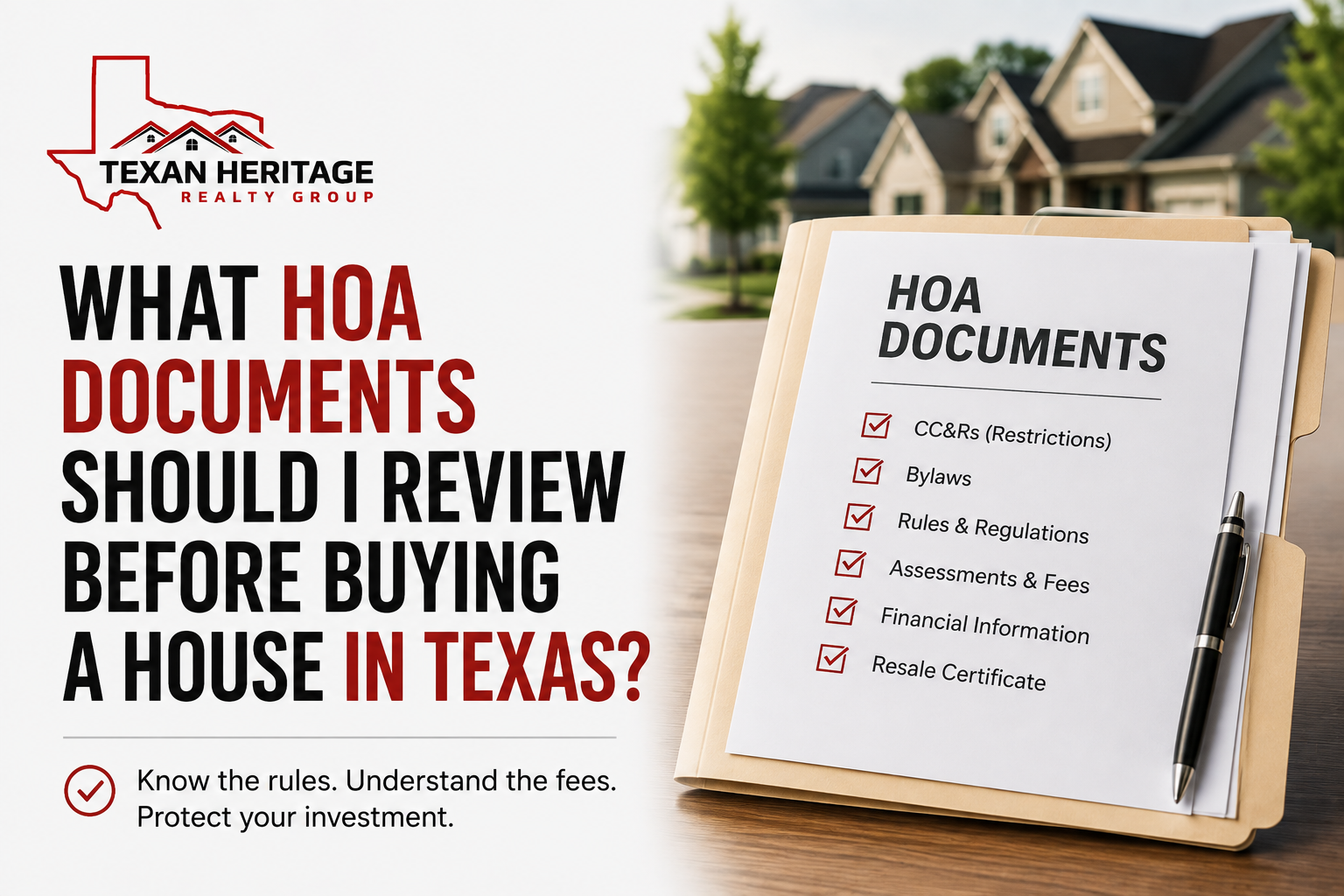
What HOA Documents Should I Review Before Buying a House in Texas?

What HOA Documents Should I Review Before Buying a House in Texas?

Quick answer: If a Texas property requires membership in a property owners association, buyers should understand the subdivision restrictions, bylaws, rules, assessments, fees, and resale-certificate information before closing. These documents can reveal financial obligations and restrictions that may materially affect how you can use the property.

You found the house.

The kitchen works. The yard is big enough. The commute makes sense.

Then somebody hands you a stack of HOA documents that looks like it could stop a door.

Don't ignore them.

When you're purchasing property subject to mandatory membership in a Texas property owners association, you're not simply buying the house.

You're also buying into a set of rules and financial obligations that may affect what you can do after closing.

What Is HOA “Subdivision Information” in Texas?

The Texas Real Estate Commission provides a form called Subdivision Information, Including Resale Certificate for Property Subject to Mandatory Membership in a Property Owners' Association.

TREC says this form complies with Chapter 207 of the Texas Property Code and provides information concerning items including assessments, judgments, rights of first refusal, and other association information.

TREC also promulgates the Addendum for Property Subject to Mandatory Membership in a Property Owners Association, and the current version was adopted in 2026.

What Should I Look for in HOA Documents?

Don't just ask, “How much are the dues?”

Review the bigger picture.

Item Question to Ask
Regular assessments How much will I owe and how often?
Special assessments Is there an additional assessment now or potentially pending?
Restrictions What can I do with the property?
Architectural rules Do exterior changes require approval?
Parking Are RVs, boats, trailers, or work vehicles restricted?
Leasing Are short- or long-term rentals restricted?
Animals Are there restrictions affecting pets or livestock?
Improvements Can I build the shop, fence, pool, or structure I want?
Association issues Are there judgments or other matters disclosed?
Transfer/resale fees What association-related charges apply?

Not every association has all of these restrictions.

That's precisely why you read the documents.

Why Does This Matter More in Some North Texas Communities?

Because buyers throughout Johnson, Tarrant, Hood, and Parker Counties aren't all shopping for the same lifestyle.

One buyer wants a suburban home in Burleson.

Another wants a gated community in Godley.

Someone moving to Granbury may specifically want a community with substantial amenities.

Another buyer wants enough room to park a boat or RV.

And someone outside Cleburne may be looking for a home where they can eventually add a workshop.

A restriction that is completely irrelevant to one buyer can be a deal-breaker for another.

Can an HOA Tell Me I Can't Park My RV or Boat at Home?

Depending on the applicable restrictions, there may be rules concerning vehicle, trailer, RV, or boat parking and storage.

Don't wait until after closing to discover them.

If you're specifically purchasing a property because the driveway looks perfect for your boat, one of the questions we should investigate is whether the applicable restrictions permit what you intend to do.

What If I Want to Build a Shop?

This comes up frequently in our market.

A buyer sees a half-acre or one-acre lot and thinks:

“Perfect. I'll put a 30x40 shop back there next year.”

Maybe.

But physical space doesn't automatically mean permission.

Potential considerations can include:

  • deed restrictions;
  • HOA architectural requirements;
  • easements;
  • setbacks;
  • city or county requirements;
  • utility locations;
  • septic-system location;
  • drainage considerations; and
  • other applicable restrictions.

This connects directly to another important due-diligence document: the survey.

A survey helps you understand where boundaries, easements, and improvements are depicted; HOA and deed restrictions help you understand some of the rules governing the property.

You want to understand both.

What About Short-Term Rentals?

If the ability to use a property as a short-term rental matters to your purchase decision, investigate that issue before closing.

Association restrictions, deed restrictions, municipal regulations, and other applicable rules may affect rental use.

Don't buy based on what the neighbor is doing.

And don't assume that because you saw another short-term rental in the subdivision, your proposed use is automatically allowed.

Verify it.

Can HOA Fees Change?

Potentially.

Buyers should understand current assessments and review association documents for the applicable rules governing assessments and association finances.

The resale-certificate process exists in part to provide buyers with meaningful information concerning the association and property.

This is another reason the monthly or annual dues amount alone doesn't tell the whole story.

Do HOA Documents Matter on New Construction?

Yes.

A brand-new home doesn't mean the community has no restrictions.

In fact, many North Texas new-construction communities have mandatory associations and architectural restrictions.

For example, buyers comparing new construction in Godley shouldn't focus solely on floor plan, builder incentives, and purchase price.

Community rules, assessments, future improvements, and lifestyle fit also belong in the decision.

Texan Heritage Realty Group currently markets new-construction opportunities in Wildcat Ridge in Godley, a gated community where understanding the community itself is part of evaluating whether a home is the right fit.

When Should I Review the HOA Documents?

As early as the transaction and applicable contract allow.

The current TREC POA addendum contains provisions addressing delivery of subdivision information and the parties' obligations. TREC's 2026 revisions also clarified portions of that addendum.

Specific deadlines and termination rights depend on the contract and circumstances, so buyers should review the actual documents governing their transaction rather than relying on a generic online timeline.

What Are the Biggest HOA Mistakes Buyers Make?

The most common problems are usually simple:

  1. Looking only at the amount of the dues.
  2. Never reading the restrictions.
  3. Assuming the current use of a neighboring property proves something is permitted.
  4. Planning a shop, pool, fence, or other improvement before reviewing restrictions.
  5. Assuming an RV or boat can be parked wherever it fits.
  6. Ignoring rental restrictions.
  7. Waiting until closing week to ask questions.

The time to find a deal-breaker is before you own the property.

Buying in an HOA Community in North Texas?

A home can be beautiful and still be wrong for the way you intend to live.

Texan Heritage Realty Group helps buyers look beyond bedrooms, bathrooms, and countertops and understand the documents and due-diligence issues that accompany the property.

Explore the Texan Heritage Realty Group home-buying process

Frequently Asked Questions

What is an HOA resale certificate in Texas?

It is association information concerning the property and POA. TREC's voluntary Form 37-5 includes information such as assessments, judgments, rights of first refusal, and other association matters and is designed to comply with Chapter 207 of the Texas Property Code.

Does every Texas house have an HOA?

No. Mandatory property owners associations apply only to certain properties and communities.

Should I read the deed restrictions even if I don't care about the HOA amenities?

Yes. Amenities and restrictions are different issues. Your concern should be whether the rules affect your intended use of the property.

Can an HOA stop me from building a fence or shop?

Applicable restrictions and architectural requirements may limit or regulate improvements. Review the actual governing documents and obtain appropriate approvals before relying on a future improvement plan.

Are HOA dues included in my mortgage payment?

Not necessarily. Buyers should determine how assessments are billed and budget for them separately when appropriate.

Can I terminate if I don't like the HOA documents?

Texas contracts can provide rights relating to subdivision information, but the answer depends on the specific contract, addendum, delivery circumstances, and deadlines. Review your actual transaction documents with your agent and seek legal advice when needed.

Is an HOA the same as deed restrictions?

Not exactly. Deed restrictions can exist independently of an active mandatory POA. Buyers should investigate both the restrictions affecting the property and any association obligations.

Buy the Community as Carefully as You Buy the House

The perfect house isn't perfect if the rules prevent you from using it the way you intended.

Whether you're buying in Burleson, Godley, Granbury, Cleburne, Fort Worth, or another North Texas community, Texan Heritage Realty Group can help you identify the questions that need answers before closing.

Search North Texas homes with Texan Heritage Realty Group

About Jason Cech

Jason Cech is a Broker Associate with Fathom Realty and team leader of Texan Heritage Realty Group. Jason has approximately a decade of real estate experience and more than 550 personal closings. He and the team help buyers throughout Johnson County and surrounding North Texas communities evaluate residential, new-construction, acreage, and community-specific considerations before purchasing.

Integrity. Tradition. Excellence.


Texan Heritage Realty Group is affiliated with Fathom Realty. This article is provided for general educational purposes and is not legal, HOA, title, lending, surveying, tax, or financial advice. Association documents, deed restrictions, contracts, and individual properties vary. Buyers should review the documents applicable to their property and consult an attorney or other appropriate professional when legal interpretation is required. Equal Housing Opportunity.

Sept. 8, 2026

How Far Should You Push a Repair Request After a Home Inspection in Texas?

How Far Should You Push a Repair Request After a Home Inspection in Texas?

Quick answer: Push hardest on defects that materially affect safety, habitability, major systems, or the cost and risk of owning the home. Electrical hazards, gas issues, active roof leaks, significant plumbing problems, HVAC failures, structural concerns, and similar deficiencies generally deserve more attention than cosmetic imperfections. In Texas, buyers commonly use the negotiated option period to inspect the property, request repairs or other changes, and decide whether they are still comfortable proceeding. TREC confirms that a buyer with an effective termination option can use that period to inspect, negotiate an amendment for repairs, or terminate within the option period.

The goal of a repair negotiation shouldn't be to make the seller fix every item in an inspection report.

It should be to answer a much more important question:

After everything we've learned about this property, are you still buying the right house on the right terms?

At Texan Heritage Realty Group, we help buyers throughout Cleburne, Johnson County, and North Texas work through this decision regularly. The best repair negotiations tend to be specific, documented, prioritized, and focused on what actually matters.

Is a Texas Home Inspection Report a Repair List?

No.

A professional inspection may identify dozens of deficiencies ranging from significant safety concerns to minor maintenance items. That does not necessarily mean asking the seller to repair every line item is the strongest negotiating strategy.

Think of the inspection as information first and a negotiation tool second.

Once the report arrives, I generally like to separate concerns into three categories.

Priority Examples Typical approach
High Gas leaks, material electrical hazards, active roof leaks, major plumbing leaks, structural concerns, major HVAC failure Investigate and negotiate seriously
Medium Aging components, drainage concerns, smaller plumbing/electrical deficiencies, damaged fixtures Evaluate cost and importance
Lower Paint, minor cosmetic damage, worn finishes, small maintenance items Usually don't risk the transaction over these alone

This isn't a legal hierarchy, and every property is different. A seemingly small inspection item can lead to a larger specialist finding, which is why judgment matters.

What Repairs Should a Texas Buyer Prioritize?

I would start with safety and major systems.

Electrical problems

Examples may include unsafe wiring conditions, damaged panels or components, improper connections, or other deficiencies your inspector believes warrant correction or specialist evaluation.

Gas-related concerns

A suspected gas leak or unsafe gas installation is not something I would treat like a cosmetic punch-list item.

Active roof leaks or significant roof problems

A roof doesn't necessarily need to be brand-new just because you're buying the house. But active water intrusion, significant damage, or conditions that could affect insurability deserve additional investigation.

HVAC problems

An older HVAC system and a nonfunctioning HVAC system are two different things.

Age alone doesn't automatically create a seller obligation. A material operational problem discovered during inspections gives us something much more concrete to evaluate.

Plumbing problems

Active leaks, sewer concerns, significant drainage issues, water-heater deficiencies, and other material plumbing problems may justify further evaluation and negotiation.

Structural concerns

If an inspector identifies conditions suggesting possible foundation or structural movement, the next step may be obtaining an appropriate specialist's opinion rather than immediately demanding a particular repair.

Should You Ask the Seller to Repair Everything?

Usually, no.

Imagine receiving a 42-page inspection report containing 35 deficiencies.

If three items could cost thousands of dollars and the other 32 are relatively minor, burying the important three inside a giant repair request can weaken the conversation.

A focused request communicates:

These are the issues that materially affect our decision to purchase this property.

That's often more effective than treating an inspection report like a wedding registry.

Should You Request Repairs or a Seller Credit?

There isn't one answer.

A buyer may prefer seller-completed repairs when the problem needs to be resolved before ownership transfers.

In other situations, the parties may negotiate a sales-price adjustment or seller contribution toward allowable closing expenses rather than having the seller perform certain work.

But those are not interchangeable.

The CFPB explains that seller credits toward closing costs can reduce the buyer's closing burden, but if the credit is being used as the economic solution to a repair problem, the buyer still needs money after closing to actually perform that repair. Seller contributions can also interact with lender requirements and appraisal considerations.

For example, suppose an HVAC issue is estimated at $6,000.

Depending on the transaction, we might evaluate:

Option A: Seller completes an agreed repair before closing.

Option B: Negotiate a price reduction.

Option C: Negotiate an allowable seller contribution toward the buyer's closing expenses, preserving more of the buyer's own funds for work after closing.

Which one is best depends on the buyer's financing, cash position, lender, appraisal, contract, seller, and nature of the problem.

If the Seller Agrees to Repairs, Who Performs Them?

This is an area where precision matters.

Under the TREC contract language governing completion of agreed repairs, unless the parties agree otherwise in writing, agreed repairs and treatments are to be completed before closing, required permits obtained, and work performed by people licensed to perform the work when licensing is legally required—or by people commercially engaged in that trade when no license is required.

Notice what that does not mean:

Every inspection item automatically has to be repaired.

And I would avoid simply telling a buyer that every negotiated repair is automatically required to be “brought to current code.” The actual written agreement, applicable laws, permits, and nature of the work control.

How Should You Document a Repair Request?

Specificity helps.

Rather than:

Fix electrical issues.

A stronger negotiation package might identify the relevant inspection-report item, include the inspector's photograph, and, when warranted, provide an electrician's evaluation or estimate.

For significant items, I like having some combination of:

  • Inspection-report page and item number
  • Inspector photographs
  • Specialist evaluation when warranted
  • Written estimate or proposal when useful
  • Clearly stated requested resolution

That gives the seller something concrete to evaluate.

When Should You Submit the Repair Request?

Promptly.

But there is no universal Texas rule saying a repair request legally must be submitted on “Day 1” or that a seller has “24 hours” to answer.

The option period itself is negotiable. TREC states that a buyer who has paid an agreed option fee and otherwise satisfied the applicable contract requirements has an unrestricted termination right during the negotiated option period. The buyer can use that time to inspect and negotiate repairs.

From a strategy standpoint, however, waiting until the last few hours is rarely ideal.

We want time to:

  1. Receive and review the inspection.
  2. Obtain specialist opinions when necessary.
  3. Decide which items matter.
  4. Send a documented request.
  5. Allow meaningful negotiation.
  6. Make a decision before the buyer's contractual rights change.

Contract deadlines matter more than artificial pressure tactics.

Should You Reinspect Seller Repairs Before Closing?

When significant repairs were negotiated, I generally want verification.

That might mean receipts, invoices, permits when applicable, photographs, a specialist's documentation, or having the inspector return to evaluate completed work.

TREC's Broker-Lawyer Committee was still discussing possible future clarification of final-walkthrough language in July 2026, so buyers and agents should rely on the actual executed contract rather than assuming proposed language is already effective.

The final walkthrough is also the buyer's opportunity to see the property's condition shortly before closing.

Finding a problem before everyone signs is preferable to discovering it while unloading the moving truck.

The Goal Isn't to “Win” the Repair Negotiation

A buyer can technically win a $300 repair argument and lose a house that otherwise made tremendous sense.

Conversely, a buyer shouldn't ignore a $15,000 problem just because they're emotionally attached to the kitchen.

Good representation means separating emotion from risk.

We ask:

How serious is it?

What might it cost?

Can it be corrected?

Who should correct it?

Does it affect financing or insurance?

And after accounting for it, does this house still make sense?

That's the negotiation.

Buying a Home in North Texas?

If you're buying in Cleburne, Burleson, Joshua, Godley, Granbury, Fort Worth, or elsewhere in North Texas, our team can help you evaluate the property, inspection findings, contract deadlines, and negotiation options.

Contact Texan Heritage Realty Group before you start touring—or before that 42-page inspection report lands in your inbox.

Frequently Asked Questions

Can a Texas buyer terminate because of inspection results?

If the buyer has an effective unrestricted termination option and gives proper written notice within the option period, TREC states that the buyer may terminate for any reason during that period. Contract circumstances vary, so buyers should rely on their executed contract.

Is a seller required to make repairs after a Texas home inspection?

Not simply because an inspector identifies a deficiency. Buyers and sellers can negotiate repairs or other amendments. TREC specifically describes the option period as a time in which inspections can occur and the parties can negotiate an amendment addressing identified repairs.

Should I ask for a new roof just because the roof is old?

Age by itself is different from damage, active leakage, functional failure, or an insurance problem. Investigate the actual condition and insurance implications before deciding what to request.

Can the seller just give me the repair money at closing?

Don't assume so. Seller contributions are governed by the transaction, contract, lender, and applicable loan requirements. A negotiated closing-cost contribution generally reduces eligible closing expenses; it should not be described as unrestricted cash handed to the buyer for repairs.

Should I have repairs reinspected?

For material repairs, I frequently recommend appropriate verification. The right method depends on what was repaired.

About Jason Cech

Jason Cech is a Broker Associate with Fathom Realty and team leader of Texan Heritage Realty Group, a Cleburne-based real estate team serving Johnson County, Fort Worth, and communities throughout North Texas. The team's agents have collectively completed more than 2,000 real estate transactions across residential, new-construction, luxury, acreage, farm-and-ranch, and land properties.


Disclaimer: Texan Heritage Realty Group is affiliated with Fathom Realty. This article is for general informational purposes and is not legal, tax, lending, insurance, engineering, or inspection advice. Contract rights depend on the executed agreement and circumstances. Consumers should consult the appropriate licensed professional when specialized advice is needed. Texas Real Estate Commission information is available through TREC. Equal Housing Opportunity.

Sept. 7, 2026

Sell My Fort Worth House This Spring? Timing the Market

Spring historically draws the most active buyers in Fort Worth, but with roughly 6,000 active listings and homes averaging 48-52 days on market in mid-2026, timing and pricing strategy matter more than the calendar. A well-prepared, correctly priced home can move in any season.


Should I sell my Fort Worth house this spring?

Spring tends to bring the highest buyer activity in Fort Worth, but the 2026 market has more inventory and longer days on market than sellers saw a few years ago. With around 6,000 active listings and homes averaging 48-52 days on market as of mid-2026, the window still favors prepared sellers, but only if your pricing and presentation are sharp from day one.

If you've been sitting on the fence about listing, here's what the current Fort Worth data actually says, and how to think about your timing decision.

What the Fort Worth Market Looks Like Heading Into Fall 2026

Let's start with the numbers, because the market has shifted enough that gut-feel timing can cost you.

According to a July 2026 report from the Fort Worth Report, Greater Fort Worth and Tarrant County homes averaged 48 days on market in June 2026, based on Greater Fort Worth Association of Realtors data. That same report noted that increased inventory has created a more balanced market for both buyers and sellers, which is a meaningful shift from the hyper-competitive conditions of 2021 and 2022.

Realtor.com's most recent Fort Worth market snapshot puts the median days on market at 52 days, with approximately 6,000 active listings and a median listing price of $348,000. They classify Fort Worth as a warm market, not a seller's market, not a buyer's market, but a market where well-positioned homes still move.

The broader Dallas-Fort Worth metro tells a similar story. The Federal Reserve Bank of St. Louis housing data, updated August 7, 2026, shows the DFW metro median days on market at 54 days in July 2026. That's a useful benchmark for context, though Fort Worth's own numbers are what matter for your listing strategy.

On the valuation side, Zillow's July 2026 Tarrant County snapshot shows a median home value of $325,177, down about 2.1% year-over-year, with roughly 6,900 for-sale listings and a median 23 days to pending. Zillow's aggregator data is softer than MLS-sourced figures, but the directional trend, slightly lower values, more inventory, lines up with what I'm seeing on the ground.

Data Point Figure Source / Date
Fort Worth median days on market 52 days Realtor.com (most recent snapshot)
Tarrant County avg. days on market 48 days (June 2026) Greater Fort Worth Assoc. of Realtors via Fort Worth Report, July 2026
DFW metro median days on market 54 days (July 2026) Federal Reserve Bank of St. Louis, Aug. 7, 2026
Fort Worth active listings ~6,000 Realtor.com (most recent snapshot)
Fort Worth median listing price $348,000 Realtor.com (most recent snapshot)
Tarrant County median home value $325,177 (down 2.1% YoY) Zillow, July 2026 snapshot

The takeaway: this is not a market where you can list at an optimistic price, sit back, and wait for offers. But it's also not a market where sellers are getting crushed. The homes that are selling are the ones priced correctly and prepared well. The ones sitting are overpriced or under-prepared.

Spring Seasonality vs. Today's Inventory Reality

Spring has historically been the strongest selling season in Fort Worth and across North Texas. More buyers are actively searching, school-year transitions drive family decisions, and longer daylight hours mean more showings. That pattern is real and it hasn't disappeared.

But here's the nuance that matters in 2026: spring doesn't automatically overcome a pricing or inventory problem. With roughly 6,000 active listings in Fort Worth alone, buyers have choices. If your home hits the market in March or April at $25,000 above where it should be, you'll burn through the spring rush and end up reducing in June, which is the worst outcome for your net proceeds.

The spring window does still offer real advantages for sellers who are ready:

  • More buyers in the pool. Families making school-year moves are most active from February through May. That buyer urgency works in your favor if your home is priced to attract offers.
  • Better showing conditions. Curb appeal is easier to achieve when lawns are green and light is good. First impressions matter more in a balanced market.
  • Faster absorption for well-priced homes. Even in a market averaging 48-52 days, correctly priced homes in areas like Fort Worth's growing corridors can go under contract significantly faster.

The spring selling season is now underway and moving into its later phase as of late August 2026. If you're weighing a fall listing versus waiting for next spring, that's a genuine strategic decision, and it depends on your home's condition, your price point, and how much competition you're willing to face. I walk my clients through exactly that analysis before we ever talk about a list date.

For a deeper look at how seasonal timing plays out locally, my post on why spring is still prime time to list breaks down the buyer behavior patterns behind the seasonality.

What Days on Market Actually Tell You

A lot of sellers look at 48-52 days on market and panic. Don't. That number is an average, it includes overpriced homes that sat for 90+ days and dragged the average up. A well-priced, well-presented home in a desirable Fort Worth neighborhood can still go pending in under two weeks.

What days on market tells you as a seller is this: you don't have the luxury of testing the market with a high price anymore. In 2021, you could list 10% above market, get multiple offers, and negotiate down from a position of strength. In 2026, an overpriced listing just sits, and a listing that sits loses credibility with buyers who assume something is wrong with it.

The first two weeks on market are still your highest-traffic window. Price it right at launch, and the days-on-market average becomes irrelevant to your sale. Price it wrong, and you'll be living that average, or worse.

Should You List Now or Wait Until Next Spring?

Here's the honest answer: it depends on factors specific to your home and situation, not on a universal "wait for spring" rule.

Reasons to list sooner rather than waiting:

  • You've already made the decision to move and carrying costs (mortgage, taxes, maintenance) are adding up
  • Your home is in strong condition and move-in ready, buyers in any season will pay for that
  • Your price point is under $350,000, where Fort Worth buyer demand remains relatively strong
  • You've done the prep work and are ready to compete on presentation

Reasons to wait and prepare:

  • Your home needs repairs or updates that would hurt your price if you listed today
  • You're not fully committed to the move yet, a half-hearted listing rarely ends well
  • You want to maximize exposure during peak buyer season, and you have the flexibility to wait

If you're leaning toward waiting, use the time well. My guide on getting your home sale-ready in North Texas walks through exactly what to tackle before you list.

The Paperwork Side: What Texas Sellers Need to Know

Timing your list date is one piece of the puzzle. The other piece is making sure you're ready to execute once you're under contract. In Texas, that means a few things sellers sometimes get caught off guard by.

For most previously occupied single-family homes, you'll need to complete the Texas Seller's Disclosure Notice. TREC updated the form effective May 28, 2026, so make sure you're using the current version. The form is required under Texas Property Code § 5.008, and it covers material facts and physical condition, it's not a warranty, but it's a legal requirement for most sales.

If your Fort Worth home was built before 1978, federal lead-based paint disclosure rules also apply. You'll need to provide any lead-related records or reports in your possession and notify buyers of any known hazards. Your agent will walk you through that as part of the contract process.

Closings in Texas go through a title company, not an attorney's office. The title company handles escrow, coordinates the closing documents, and ensures the title transfers cleanly. Getting your disclosure paperwork in order early, before you're under contract, keeps the transaction moving smoothly once you have a buyer.

Every situation is different, and the only way to know whether now is your right moment is to run the numbers with someone who knows this market. That's the conversation I have with every seller before we talk list dates.

If you've found this helpful, I'd appreciate you taking a moment to share your experience: read my reviews on Google, Zillow, or Realtor.com.

Frequently Asked Questions

Is spring really the best time to sell a house in Fort Worth?

Spring historically brings the highest buyer activity in Fort Worth, driven by families planning school-year moves and general seasonal momentum. That pattern still holds in 2026, but elevated inventory means spring alone won't carry an overpriced or under-prepared listing. The sellers who do best in spring are the ones who enter the market priced correctly and ready to show well from day one.

How many days does a Fort Worth house usually stay on the market right now?

The most recent data shows Tarrant County homes averaged 48 days on market in June 2026, according to Greater Fort Worth Association of Realtors data reported by the Fort Worth Report. Realtor.com's current Fort Worth snapshot puts median days on market at 52 days. These are averages, well-priced, move-in-ready homes in strong locations routinely go pending faster than the average suggests.

Should I list my Fort Worth home now or wait until next spring?

There's no universal right answer. If your home is in strong condition, you're committed to moving, and you're priced correctly for today's market, listing sooner avoids the carrying costs of waiting six or more months. If your home needs meaningful prep work or you want maximum spring buyer traffic, a well-executed spring launch can be worth the wait. The decision depends on your home's condition, price point, and personal timeline, a market analysis with a local agent gives you the clearest picture.

What does months of inventory mean in the Fort Worth housing market?

Months of inventory measures how long it would take to sell all current listings at the current pace of sales. A balanced market is generally considered around 4-6 months of supply. Fort Worth's roughly 6,000 active listings, combined with current absorption rates, puts the market in or near that balanced range, which means buyers have real choices, and sellers need to compete on price and condition rather than assuming demand will paper over any weakness in their listing.

Do I need a title company to close a home sale in Texas?

Yes. In Texas, home sale closings are handled through a title company, which manages escrow, coordinates closing documents, and ensures the title transfers to the buyer free of defects. You don't use a closing attorney for a standard residential transaction in Texas. Your agent will typically recommend a title company, though you have the right to choose your own.

Does the Texas Seller's Disclosure Notice apply to every home sale?

It applies to most previously occupied single-family residential homes. TREC updated the form effective May 28, 2026, so sellers should confirm they're using the current version. There are limited exemptions, such as certain foreclosure sales or transfers between family members, but for a standard Fort Worth resale, the disclosure is required. Your agent will provide the form and walk you through completing it accurately.


The bottom line: Fort Worth is a warm, balanced market in 2026, not a slam dunk for sellers, but absolutely workable for those who approach it with the right strategy. If you're ready to find out what your home is worth and whether now is your moment, start with a free home valuation from my team. We cover Fort Worth, Burleson, Cleburne, Aledo, Weatherford, and the surrounding communities, and we'll give you a straight answer, not a sales pitch.

About Jason Cech

Jason Cech is the Owner and Broker Associate of Texan Heritage Realty Group in Cleburne, Texas, with over 9 years of real estate experience helping families buy and sell across Johnson County, Fort Worth, and North Texas. A DFW Real Producers Top 500 Agent and multi-year top producer, he leads his team with a client-first approach built on integrity, tradition, and excellence.

Fathom Realty · 817-776-8319

This article is for general informational purposes only and does not constitute legal, tax, or financial advice. Market conditions change; verify current figures and your own transaction costs with your title company, tax advisor, or lender. Jason Cech | Broker: Fathom Realty | Licensed by the Texas Real Estate Commission (TREC) | TREC: Information About Brokerage Services | TREC: Consumer Protection Notice | Equal Housing Opportunity.

Sept. 4, 2026

Cost to Sell a House in Fort Worth: Seller Net Sheet

Selling a house in Fort Worth involves several cost categories beyond commission: title company fees, prorated Tarrant County property taxes, HOA transfer and resale certificate fees, recording charges, and any buyer concessions. Your actual net proceeds appear on the title company's settlement statement after every debit and credit is applied.


What does it actually cost to sell a house in Fort Worth, and what will I net at closing?

Selling a house in Fort Worth means your net proceeds are determined not by the contract price alone, but by the full stack of costs the title company applies on the settlement statement: loan payoffs, title and escrow charges, prorated Tarrant County property taxes, HOA fees, recording charges, broker compensation, and any concessions you negotiate with the buyer. Every category is real, several are negotiable, and the gap between your contract price and your actual check at closing is almost always larger than sellers expect.

The Fort Worth Market in 2026: Why Your Starting Price Matters

Before you can think about what you'll net, you need a realistic picture of where Fort Worth prices actually are right now.

According to the Fort Worth Report's July 2026 coverage of Greater Fort Worth Association of REALTORS® data, the June 2026 median sale price in Fort Worth was $335,975, with 1,067 homes sold (up 5.2% year-over-year) and about 3.8 months of inventory. That inventory figure is the headline: this is a more balanced market than the peak seller years of 2020 through 2022.

Redfin's Fort Worth market data for the three months ending June 2026 puts the median sale price at approximately $340,000, down roughly 0.05% year-over-year. Zillow's Fort Worth page shows a 2026 median sale price around $329,833 against a median list price of roughly $343,983, illustrating that homes are regularly selling below list.

Why does this matter for your net sheet? In a balanced market, buyers ask for more. Closing cost credits, repair requests, and price reductions after inspection are all more common today than they were three years ago. Your contract price is the ceiling, not the floor, of what you'll walk away with.

Data Source Fort Worth Median Sale Price (2026) Market Context
Fort Worth Report / GFWAR (June 2026) $335,975 ~3.8 months inventory; more balanced conditions
Redfin (3 months ending June 2026) ~$340,000 Down ~0.05% year-over-year
Zillow (2026 estimate) ~$329,833 Median list price ~$343,983; gap signals price cuts

I walk every seller through this context before we price the home. The number on the contract is only the beginning of the conversation.

The Real Seller Cost Stack: Every Line Item on Your Settlement Statement

Here is what actually shows up as a debit on your side of the closing statement at a Fort Worth title company. None of these are surprises if you know to look for them.

Loan Payoffs and Liens

Your first mortgage payoff is typically the largest single debit on your settlement statement. If you have a second mortgage, a home equity loan, or any judgment or mechanics' liens, those clear from proceeds at closing too. The title company orders payoff statements from each lienholder and coordinates the wire. A title search run early in the process can surface liens you may not know about, and any that appear must be resolved before the deed transfers.

Title Company Fees

In Fort Worth, closings happen at a title company, full stop. The title company acts as escrow agent, prepares and records the deed, coordinates all payoffs, and issues title insurance policies. Their charges to the seller typically include an escrow or settlement fee, document preparation, and potentially wire or courier fees if you're signing remotely.

Title insurance itself is a commonly negotiated item. Texas Real Estate Commission (TREC) standard contracts address who pays for the owner's policy and the lender's policy, but those allocations are negotiable between the parties. Local convention in North Texas gives you a starting point, but your contract language is what controls. Ask your agent to walk you through how the title insurance section reads in your specific offer.

Tarrant County Recording Fees

Once the title company prepares the general warranty deed and any lien releases, those documents get filed with the Tarrant County Clerk. Per the fee schedule effective January 1, 2024, and still in effect as of August 2026, recording costs $20 for the first page and $4 for each additional page. These are modest but real line items. Who pays is a matter of contract negotiation, not a county rule.

Prorated Property Taxes

This is the one that catches Fort Worth sellers off guard most often.

Texas property taxes are paid in arrears, meaning you owe taxes for the portion of the year you owned the home. At closing, the title company calculates how many days of the tax year you owned the property and credits the buyer for that share. If the current year's tax bill isn't set yet, the calculation uses an estimate based on the prior year's bill.

The catch: Tarrant County property taxes are a composite of multiple taxing entities. The Tarrant County Tax Office rates and exemptions page shows that your total tax bill reflects the county, the city of Fort Worth, your school district, and potentially other special districts, all layered together. The Truth in Taxation Summary publishes the most recently adopted rates for each entity.

If your home's appraised value increased significantly in recent years (which is common across Tarrant County), your prorated tax share at closing will reflect that higher valuation. Sellers who budgeted based on an older tax bill sometimes see a larger-than-expected debit on the settlement statement. The county's property tax overview is a good starting point to understand your current exposure before you list.

There is no statewide statute that mandates one specific proration method. The TREC standard contracts include a tax proration clause, but the exact formula and any true-up when the actual bill arrives are governed by your contract language. This is worth reviewing with your agent before you sign anything.

HOA and POA Items

If your home is in a homeowners' association or property owners' association, expect several potential line items at closing. Under Texas law, sellers in mandatory HOA communities must provide buyers with a resale certificate that discloses dues status, pending assessments, and any violations. The cost of obtaining that certificate is real, and it is contractually negotiable.

Beyond the resale certificate, many associations charge a transfer fee when ownership changes. Past-due dues, special assessments, or outstanding fines must be cleared from proceeds before the title company will close. In newer master-planned communities in far North Fort Worth and the Alliance corridor, you may have both a master association and a sub-association, each with their own fee structure.

I always tell sellers in HOA communities to ask the title company to order the resale certificate early in the contract period. Delays in getting that document can push your closing date, and unexpected fees can catch you off guard if you haven't budgeted for them. For a deeper look at what the TREC Seller's Disclosure Notice requires you to report, including HOA-related items, my post on what you have to disclose when selling in Texas breaks it down in plain language.

Broker Compensation

Broker compensation is one of the larger line items on your settlement statement. The amount is fully negotiable and not set by any law, association, or standard rate. There is no typical or customary percentage. What you pay is determined by your listing agreement with your broker, full stop.

Since the 2024 NAR settlement, the structure of how buyer's agent compensation works has also changed. Any compensation offered to a buyer's broker is a separate, optional negotiation, not an automatic seller obligation, and it is not advertised through the MLS. Your listing agreement covers your side; the purchase contract addresses any buyer-side compensation arrangement. Review both documents carefully, and if you have questions about how compensation is structured in a specific offer, that is a conversation to have directly with your agent before you sign.

Buyer Concessions and Credits

In the more balanced 2026 Fort Worth market, concessions are back. Buyers are more frequently asking for closing cost credits, repair credits after inspection, and home warranties. Each of these is a direct debit from your proceeds.

A closing cost credit reduces what the buyer brings to closing but comes out of your net. A repair credit works the same way. A home warranty, if you agree to provide one, is a line item the title company collects and remits. None of these show up in your contract price, but all of them show up on your settlement statement.

The Fort Worth Report's July 2026 market analysis makes clear that with 3.8 months of inventory, buyers have more leverage than they did during the peak years. Budget for some level of concession before you list, and you won't be blindsided when an offer comes in with requests attached.

The Texas Seller's Disclosure and Its Effect on Your Net

The TREC Seller's Disclosure Notice is required for previously occupied single-family homes under Section 5.008 of the Texas Property Code. You complete it early in the transaction, and whatever you disclose becomes a negotiation data point for the buyer.

Past foundation repairs, roof replacements, prior flood events, or unresolved insurance claims all have a way of generating inspection contingencies, repair requests, or price adjustments. This doesn't mean you hide anything; it means you go in with eyes open about how disclosed items can translate into concessions. If there are known issues with the property, a pre-list inspection and a repair strategy before you hit the market can protect your net better than discovering problems after you're already under contract.

Other Items That Show Up

  • Survey costs if your existing survey is unacceptable to the buyer or their lender and the parties agree the seller will provide a new one. Surveys are a common negotiation point in Texas contracts.
  • Utility adjustments if local practice or contract terms call for settling municipal utility balances at closing.
  • Staging or pre-list repair invoices if you choose to pay those from proceeds rather than out of pocket before closing.

For sellers in Cleburne and Johnson County specifically, the cost categories are similar but the tax entity composition and HOA landscape differ. I cover those details in my post on the cost to sell a house in Cleburne, TX. And if you want the full net proceeds picture for both Johnson and Tarrant County, my post on what you'll net when you sell in Johnson and Tarrant County in 2026 goes deeper on the math side of the conversation.

How to Actually Use This Before You List

The single best thing you can do before you set a list price is ask for a draft net sheet. A good listing agent and your title company can model out your estimated proceeds using your current mortgage payoff, your HOA situation, your Tarrant County tax liability, and realistic assumptions about concessions in today's market. That draft won't be exact, but it will tell you whether your financial goals are achievable at a given price point before you sign a listing agreement.

Here's what I do with every seller I work with in Fort Worth, Burleson, Cleburne, Godley, Joshua, and across North Texas: we sit down with a realistic cost picture before we price the home. Not after an offer comes in, not at the closing table. Before. That way, the number on the contract is one you've already stress-tested against the full cost stack, and there are no surprises when the settlement statement lands in front of you.

If you want to get that picture for your specific situation, start here for a free home valuation and we'll build the real numbers together.

You can also read what past clients have said about working with our team on Google, Zillow, and Realtor.com.

Frequently Asked Questions

What closing costs do sellers usually pay in Fort Worth, and which ones can I negotiate?

Sellers in Fort Worth typically see debits for loan payoffs, title and escrow fees, prorated Tarrant County property taxes, HOA resale certificate and transfer fees, recording charges, broker compensation, and any buyer concessions or credits. Most of these are negotiable between the parties in the purchase contract, including who pays for title insurance and recording fees. The one constant is that your existing mortgage payoff is not negotiable; everything else has some flexibility depending on what you agree to in writing.

How are property taxes prorated when I sell my house in Tarrant County, and could that change my net proceeds?

Texas property taxes are paid in arrears, so at closing the title company calculates the portion of the year you owned the home and credits that amount to the buyer from your proceeds. Tarrant County taxes are a composite of multiple entities, including the county, city, school district, and others, so the combined rate can be higher than sellers expect. If your home's appraised value has increased in recent years, your prorated share at closing will reflect that. The exact proration method is governed by your contract language, not a statewide mandate.

Do I have to use a title company to sell a house in Texas, and what seller fees show up on the settlement statement?

In practice, virtually all residential closings in Fort Worth and North Texas are handled by a title company. The title company acts as escrow agent, prepares and records the deed, coordinates payoffs, calculates prorations, and issues title insurance. Seller-side fees on the settlement statement typically include escrow or settlement charges, document preparation, recording fees, title insurance (as allocated in the contract), prorated taxes, HOA items, and any agreed concessions. The title company walks you through each line before you sign.

What is the Texas Seller's Disclosure, and how can what I disclose affect buyer requests or concessions?

The TREC Seller's Disclosure Notice is a mandatory form for previously occupied single-family homes in Texas, required under Section 5.008 of the Texas Property Code. It asks you to disclose known material facts and the physical condition of the property, including systems, structural issues, prior repairs, and insurance history. Items you disclose often become negotiation points: buyers may request repair credits, price reductions, or additional inspections based on what the form reveals. Being upfront and having a plan for known issues before you list generally protects your net better than discovering problems mid-contract.

If my home is in an HOA in Fort Worth, what kind of transfer or resale fees should I expect at closing?

Texas law requires sellers in mandatory HOA communities to provide buyers with a resale certificate disclosing dues status, pending assessments, and violations. The cost of obtaining that certificate is a real closing line item, and it is contractually negotiable. Many associations also charge a transfer fee when ownership changes. In newer master-planned communities in North Fort Worth or the Alliance area, you may have both a master and a sub-association, each with separate fees. Past-due dues, special assessments, or outstanding fines must be cleared from your proceeds before the title company will close.

How do Fort Worth's 2026 inventory levels affect how much buyers ask for in closing cost help?

With approximately 3.8 months of inventory as of June 2026, according to Fort Worth Report's coverage of GFWAR data, the market is more balanced than it was during the 2020 to 2022 peak. Buyers have more options and more negotiating leverage, so requests for closing cost credits, repair credits, and home warranties are more common. Sellers who build a realistic concession estimate into their pre-list net sheet are better positioned to evaluate offers clearly and avoid surprises at closing.

About Jason Cech

Jason Cech is the Owner and Broker Associate of Texan Heritage Realty Group in Cleburne, Texas, with over 9 years of real estate experience helping families buy and sell across Johnson County, Fort Worth, and North Texas. A DFW Real Producers Top 500 Agent and multi-year top producer, he leads his team with a client-first approach built on integrity, tradition, and excellence.

Fathom Realty · 817-776-8319

Equal Housing Opportunity. Jason Cech, Broker Associate, Fathom Realty, licensed by the Texas Real Estate Commission (TREC). This article is general information only and does not constitute legal, tax, or financial advice. Confirm your specific costs and net proceeds with your title company, tax advisor, or lender. TREC: Information About Brokerage Services | Consumer Protection Notice.

Sept. 2, 2026

Should I Sell My House Before Buying Another Home in Texas?

Should I Sell My Current House Before Buying Another Home in Texas?

Quick answer: It depends on your finances, risk tolerance, available equity, and the strength of your local market. Some Texas homeowners sell first, some buy first, and others make their next purchase contingent on the sale of their existing property. The best strategy is usually determined before either home hits a contract—not after.

This is one of the most common questions we hear from move-up buyers:

“Jason, how in the world do I sell this house and buy the next one without ending up homeless—or owning two houses?”

That's a fair question.

Buying your first house has plenty of moving pieces.

Selling one house while simultaneously buying another adds an entirely different level of coordination.

The good news is there isn't just one way to do it.

What Are My Options If I Need to Sell and Buy at the Same Time?

Most homeowners fall into one of these general strategies:

Strategy Main Advantage Main Risk
Sell first, then buy Know exactly how much equity you have May need temporary housing
Buy first, then sell Easier move and less timing pressure Could temporarily carry two homes
Buy contingent on selling Reduces risk of owning two homes Can make your offer less attractive
Coordinate both closings Potentially seamless transition Requires strong timing and coordination

The right answer depends on your situation.

Can I Make an Offer Contingent on Selling My Current Texas Home?

Potentially.

The Texas Real Estate Commission promulgates the Addendum for Sale of Other Property by Buyer, Form 10-6. TREC describes it as the addendum used when buyers will be unable to purchase the new property unless their existing property is sold and closed.

That does not mean every seller will accept a contingent offer.

The strength of that offer depends heavily on circumstances.

A seller may view these situations very differently:

Scenario A: Your existing home is already under contract with a well-qualified buyer and approaching closing.

Scenario B: Your home isn't even listed yet.

Both may technically involve a home-sale contingency, but they don't carry the same level of uncertainty for the seller.

Is a Contingent Offer Weaker?

It can be.

Imagine you're selling a home in Burleson and receive two similar offers.

One buyer can close without selling another property.

The second buyer needs to list a house, find a buyer, get through inspections, satisfy financing and appraisal requirements, and close that transaction before purchasing yours.

All else being equal, the first offer presents fewer moving parts.

But all else isn't always equal.

Price, financing, closing date, earnest money, option terms, the status of the buyer's existing home, and other negotiated terms can influence how a seller evaluates an offer.

That's why strategy matters.

Should I Put My Current House on the Market Before Shopping?

For many homeowners, this is worth serious consideration.

One of the biggest mistakes is finding the next house first and then deciding what to do with the current one.

At Texan Heritage Realty Group, we would rather work backward from your goal.

A practical planning sequence looks like this:

  1. Estimate your current home's realistic market value.
  2. Estimate your likely equity after mortgage payoff and selling expenses.
  3. Talk with your lender about purchasing power and whether you can qualify before selling.
  4. Determine whether temporary double payments are financially realistic.
  5. Discuss the likely time required to sell your existing home.
  6. Build the sale-and-purchase strategy.
  7. Only then decide when to list and when to begin making offers.

That puts the plan ahead of the emotion.

How Much Equity Will I Have to Put Toward the Next Home?

Start with an estimate—not the Zestimate, not what your neighbor says their house is worth, and not simply the highest active listing in your subdivision.

You need to consider:

Expected sales price
– mortgage payoff
– anticipated seller expenses
– any other liens or transaction obligations
= estimated net proceeds

Those net proceeds may become part of your down payment and closing funds on the next property.

This is why getting an accurate pricing and net estimate before shopping can be so useful.

Request a home-value consultation from Texan Heritage Realty Group

What If I Can Qualify to Buy Before Selling?

That can create more flexibility.

If your lender confirms you can comfortably purchase the next property without first closing your existing home, you may be able to write an offer without a sale contingency.

But qualification and comfort aren't necessarily the same thing.

Ask yourself:

Could we make both payments if our old house takes 30 days longer to sell than expected?

What if we need to reduce the price?

What if the buyer on our existing home terminates and we have to go back on the market?

A plan that works only when everything goes perfectly isn't much of a plan.

What About Bridge Loans or Other Financing Options?

Some buyers may have access to bridge financing, home-equity strategies, recasting, or other lender-specific programs.

Those products can potentially solve timing problems, but availability, qualification, cost, and risk vary substantially.

That's a conversation to have with a qualified lender before relying on one of these strategies.

Your real estate agent and lender should be communicating early.

Can I Close on Both Houses the Same Day?

Sometimes, yes.

For example, a homeowner might sell a house in Cleburne in the morning and use proceeds from that transaction toward a purchase in Godley later that day.

But same-day closings create dependencies.

The first transaction must fund appropriately for money to move where it needs to go. Delays involving documents, lender funding, title issues, or the other party can potentially affect the second closing.

When transactions depend on each other, everyone needs to understand the sequence.

What If I Need More Time to Move Out?

Closing and physical possession don't always have to happen at exactly the same moment.

Depending on the transaction, buyers and sellers can negotiate possession arrangements. TREC's current forms include temporary residential lease forms for situations in which possession timing differs from closing. TREC lists the current Buyer’s Temporary Residential Lease as effective January 5, 2026.

These arrangements create legal and practical considerations and must be structured appropriately.

Sometimes an extra day or two can make the difference between an organized move and loading the moving truck like you're competing on a game show.

Does the Local Market Change the Strategy?

Very much so.

A seller with a highly desirable, well-priced property in Burleson may have more confidence about selling quickly than someone whose property has significant condition issues or competes against substantial inventory.

Likewise, a buyer pursuing a property with multiple offers may have less negotiating leverage for a sale contingency than a buyer making an offer on a home that has been sitting on the market.

This is where broad national real estate advice breaks down.

Your strategy should be based on the home you're selling, the home you're buying, and the local market surrounding each one.

Planning to Sell and Buy in North Texas?

This is one transaction where planning early can prevent a tremendous amount of stress.

Texan Heritage Realty Group can evaluate your current property, estimate your likely net proceeds, coordinate with your lender, and develop a timeline for selling and purchasing before you're forced to make rushed decisions.

Start with the Texan Heritage Realty Group seller guide

Frequently Asked Questions

Do I have to sell my house before buying another one?

No. Whether you need to sell first depends largely on your finances, lender qualification, and preferred level of risk.

Can I use the equity from my current home as the down payment on my next house?

Potentially, but the timing of when those proceeds become available matters. Your lender and title company should be involved in planning the transaction.

Can a seller reject my offer because I have to sell my house first?

A seller generally evaluates the offers and terms presented and may prefer an offer with fewer contingencies. Your agent can help structure and explain the strength of your position.

Should I list my home before finding the next one?

Sometimes. The best sequence depends on your local market, financial flexibility, and housing options. We recommend determining the strategy before you become emotionally committed to another property.

What happens if my buyer backs out?

Your rights and obligations depend on the contract and circumstances. If your purchase depends on the successful closing of your sale, a disruption in the first transaction can affect the second—which is precisely why the contracts and timelines need careful coordination.

Can I stay in my old house after it closes?

Possibly, if an appropriate possession arrangement is negotiated and documented. Do not assume you can remain after closing without an agreement.

Don't Coordinate Two Transactions by Accident

Selling and buying simultaneously isn't simply two ordinary transactions happening next to each other.

They can become one interconnected financial and logistical plan.

Texan Heritage Realty Group helps North Texas homeowners build that plan before the first sign goes in the yard.

Talk with Texan Heritage Realty Group about selling and buying

About Jason Cech

Jason Cech is a Broker Associate with Fathom Realty and team leader of Texan Heritage Realty Group. Jason has approximately a decade of real estate experience and more than 550 personal closings. He and his team represent buyers and sellers throughout Johnson County and surrounding North Texas communities and regularly help clients coordinate sale-and-purchase transactions.

Integrity. Tradition. Excellence.


Texan Heritage Realty Group is affiliated with Fathom Realty. This article provides general educational information and is not legal, lending, tax, financial, or title advice. Contract rights and financing requirements depend on the documents and circumstances of the individual transaction. Consult the appropriate licensed professional regarding your situation. Equal Housing Opportunity.

Sept. 2, 2026

Should I Get a Home Insurance Quote Before Making an Offer on a House in Texas?

Should I Get a Home Insurance Quote Before Making an Offer on a House in Texas?

Quick answer: Yes. While you may not need a finalized homeowners policy before making an offer, Texas buyers should investigate insurance costs and insurability early—especially when considering an older home, an older roof, acreage, previous claims, or a property with unusual features. The insurance premium can materially change your monthly payment, and an insurance problem discovered late in the transaction can potentially affect financing or closing.

Most buyers know they need to think about the mortgage payment.

Fewer buyers think about homeowners insurance until they're already under contract.

In Texas, that can be an expensive mistake.

The Texas Department of Insurance has been encouraging consumers to shop their homeowners coverage rather than assume every company will offer the same price or coverage. Texas has a competitive insurance market, but premiums, deductibles, roof coverage, underwriting requirements, and willingness to insure a particular property can vary significantly from one carrier to another.

For buyers in Cleburne, Burleson, Joshua, Godley, Granbury, Weatherford, Fort Worth, and throughout North Texas, we recommend making insurance part of the home-buying conversation earlier rather than later.

Why Should I Check Insurance Before I Fall in Love With a House?

Because the price of the house isn't the same thing as the cost of owning it.

Imagine comparing two homes at exactly the same purchase price.

Home Purchase Price Insurance Considerations
Home A $350,000 Newer roof, straightforward underwriting
Home B $350,000 Older roof, prior claims, higher quoted premium
Difference $0 Potentially meaningful monthly ownership-cost difference

The mortgage principal and interest could be virtually identical.

The actual monthly payments may not be.

That's why Texan Heritage Realty Group encourages buyers to look beyond the list price and consider the total cost of ownership.

Can the Age of a Roof Affect Homeowners Insurance in Texas?

Absolutely.

The Texas Department of Insurance specifically advises homeowners to verify the age and material of their roof because insurance coverage can vary based on roof age and condition.

Some policies provide replacement-cost coverage for roofs. Others may pay less based on age and condition, and some insurers may limit or decline roof coverage when a roof is in poor condition. TDI also notes that newer roofs may qualify for better rates with some insurers.

That means the question isn't simply:

“Does the roof leak?”

A buyer should also be asking:

“How old is the roof, and how will my insurance company treat it?”

Those are two very different questions.

Can a House Pass Inspection but Still Have an Insurance Problem?

Yes.

A home inspection and an insurance underwriting decision serve different purposes.

An inspector might tell you that a roof is currently performing as intended but is approaching the end of its expected useful life.

An insurance company may look at that same roof differently when deciding whether to insure the property, what coverage to provide, or what premium to charge.

The same concept can apply to other property characteristics.

That's one reason we don't want a buyer waiting until a few days before closing to start asking insurance questions.

What Does Homeowners Insurance Usually Cover—and What Might It Not Cover?

Coverage varies by policy, so buyers should have an insurance professional explain the actual policy being offered.

TDI notes that homeowners insurance policies generally do not cover flood damage. Depending on the property and financing, separate flood insurance may be required or advisable.

A buyer should understand:

  • the annual premium;
  • dwelling coverage;
  • replacement-cost versus actual-cash-value provisions;
  • wind and hail deductible;
  • other deductibles;
  • roof coverage;
  • water-related coverage and exclusions;
  • liability coverage;
  • whether additional flood coverage is appropriate; and
  • any underwriting requirements that must be completed after closing.

Don't compare policies based only on the annual premium.

A cheaper policy with substantially different coverage isn't necessarily the better deal.

Why Are Wind and Hail Important in North Texas?

Because they are major sources of homeowners insurance losses in Texas.

In June 2026, TDI released expanded public insurance data and reported that Texas insurers paid $8.74 billion in homeowners losses during 2025 across wind and hail, water, fire, theft, liability, and vandalism categories. TDI said wind and hail have accounted for an average 62% of homeowners losses since 2019.

That doesn't mean every North Texas homeowner will have a claim.

It does help explain why roof condition, deductibles, and wind/hail coverage deserve more than a quick glance.

When Should a Texas Buyer Start Shopping for Insurance?

Our preferred sequence looks something like this:

Stage Insurance Action
Preapproval Estimate insurance when discussing your target payment
Home search Notice roof age, condition, location, and unusual property features
Serious interest Ask your insurance professional whether anything obvious could affect coverage
Under contract Obtain actual quotes promptly
Inspection period Coordinate inspection findings with insurance questions where appropriate
Before closing Confirm acceptable coverage is bound and lender requirements are satisfied

This doesn't mean buyers need to request a full insurance quote on every house they tour.

It means don't treat insurance as a closing-week afterthought.

What If I'm Buying an Older Home in Cleburne or Weatherford?

This becomes even more important.

North Texas isn't one uniform housing market.

A buyer may look at a newer subdivision home in Godley one afternoon and tour a 1950s or 1960s home in Cleburne the next morning.

Those properties can present very different questions involving roofs, electrical systems, plumbing, prior improvements, and insurability.

The older house may still be the better purchase.

You simply want to understand the costs before you're committed to owning it.

What If an Insurance Company Won't Insure the Home?

Don't immediately assume the transaction is dead.

Start by finding out why.

As of January 1, 2026, a new Texas law requires insurance companies to provide written reasons for certain decisions to decline, cancel, or not renew home insurance. TDI notes that unrepaired prior damage can be one reason an insurer has concerns.

Buyers can also shop other carriers because underwriting standards vary.

For consumers who cannot obtain coverage in the regular market, the Texas FAIR Plan may provide limited coverage when eligibility requirements are satisfied, including having been declined by at least two insurers and not having received an offer for the same level of coverage elsewhere.

That is a conversation for your insurance professional and lender—not something to discover at the closing table.

Don't Shop for a Home Based Only on the List Price

Buying well means understanding the complete transaction.

Texan Heritage Realty Group helps buyers throughout Johnson County and surrounding North Texas communities coordinate the moving pieces—property analysis, offer strategy, inspections, appraisal, title, survey, insurance questions, financing, and closing.

Start your North Texas home search with Texan Heritage Realty Group

Frequently Asked Questions

Do I need homeowners insurance to get a mortgage in Texas?

Mortgage lenders generally require borrowers to maintain acceptable property insurance as a condition of the loan. Your lender and insurance professional should explain the specific requirements for your financing.

Should I get multiple home insurance quotes?

Yes. TDI recommends shopping and comparing insurers. Price, coverage, deductibles, complaint history, and financial strength can all matter.

Does a newer roof make homeowners insurance cheaper?

Potentially. TDI says some insurers offer discounts for newer roofs or certain materials, but pricing and underwriting vary by company.

Does homeowners insurance cover flooding?

Standard homeowners policies generally do not cover flood damage. Separate flood insurance may be appropriate or required depending on the property and financing.

Can I change insurance companies after buying the house?

Generally, homeowners can shop for other coverage, subject to lender requirements and avoiding gaps in coverage. TDI specifically advises consumers not to cancel an existing policy until replacement coverage is secured.

Should I ask about insurance before the inspection?

You don't necessarily need a finalized policy first, but beginning the insurance conversation early can help identify potential concerns while you still have time to evaluate them.

Buying a Home in North Texas?

Before you focus only on interest rate and purchase price, make sure you understand what the home may actually cost to own.

Texan Heritage Realty Group can help you evaluate the entire transaction and connect the right questions to the right professionals before closing.

Connect with Texan Heritage Realty Group

About Jason Cech

Jason Cech is a Broker Associate with Fathom Realty and team leader of Texan Heritage Realty Group. Jason has approximately a decade of real estate experience and more than 550 personal closings. He and the Texan Heritage Realty Group team represent buyers and sellers throughout Johnson County and surrounding North Texas markets.

Integrity. Tradition. Excellence.


Texan Heritage Realty Group is affiliated with Fathom Realty. This article is for general educational purposes and is not insurance, legal, lending, tax, inspection, engineering, or financial advice. Insurance availability, underwriting, premiums, deductibles, and coverage vary by carrier, property, and consumer. Consult a licensed insurance professional and your lender regarding your specific transaction. Equal Housing Opportunity.

Sept. 2, 2026

Relocating to North Texas: Burleson & Weatherford Guide

Relocating to North Texas means choosing between fast-growing suburbs like Burleson, with strong commuter access to Fort Worth and median home prices around $340,000, and Weatherford, a historic exurban community west of Fort Worth with generally lower price points. Both offer a compelling mix of affordability, job-market access, and quality of life.


What do I need to know before relocating to Burleson or Weatherford in North Texas?

Relocating to North Texas means picking a community that fits your commute, your budget, and the lifestyle you're after. Burleson sits south of Fort Worth along a well-traveled corridor into the city, with median home values near $340,000 and one of the faster-growing suburban profiles in the region. Weatherford, the seat of Parker County, sits west of Fort Worth with a historic downtown character and generally lower home prices. Both are legitimate landing spots for relocating families, the right choice depends on which tradeoffs matter most to you.

Why North Texas Keeps Drawing Relocators

The numbers behind DFW's growth aren't hype. According to the City of Fort Worth's official population page, Fort Worth has been the fastest-growing large U.S. city (among the top 30 most populous) since 2020, with population growth of 11.9% over five years and approximately 2% in the most recent year reported as of its August 2026 update. A Dallas Fed Fort Worth Economic Indicators report from July 2026 adds that Fort Worth's population has grown an average of 2.2% per year over the prior 15 years, outpacing both its metro division and the broader DFW area.

The job market backs that growth up. The Fort Worth Report's July 2026 summary of a new local economic report found that Fort Worth employment grew at an annualized rate of 3.4% over the three months ending in May 2026, with monthly annualized rates between 1.6% and 2.6% in April and May. That's not a fluke, the Dallas Fed's DFW Economic Indicators tracked annualized DFW employment growth of 2.5% in August 2025 after a flat July, and the Dallas Regional Chamber's October 2025 Economy in Brief placed DFW 6th among large U.S. metros for year-over-year job growth. The region's employment base spans professional services, logistics, healthcare, education, defense, and energy, which means relocators aren't betting on a single industry.

I work with relocating families across Johnson County, Tarrant County, and Parker County every year. The question I hear most isn't "should I move to North Texas?", it's "which part is right for us?" That's where the real work starts.

Burleson: Southern Corridor, Strong Growth, Family-Oriented

Burleson sits primarily in Johnson County, with a portion extending into Tarrant County. It's a direct commuter corridor into Fort Worth, and its growth story is hard to ignore. According to MoveWithJG's Burleson profile, the city has seen roughly 25% population growth since the 2020 Census, including about 4% growth in 2023 alone. The median age is approximately 34.9 years, median household income was around $94,000 in 2023 (well above both Texas and U.S. medians), and the homeownership rate sits above 70%.

On the housing side, the most recent data available as of August 26, 2026 comes from a local guide referencing Zillow's Home Value Index, which measured a median sale price of approximately $340,650 in May 2026, down about 1.3% year-over-year. Median days to pending was 25 days, meaning homes were still moving in under a month at the median. For context, a MoveWithJG market report from July 2025 showed a median of $353,255 at that point, up 3.9% from the prior year, so values have moderated slightly from mid-2025 highs, which is actually good news for buyers relocating now.

Housing costs in Burleson have historically run roughly 10-15% below the national average, according to neighborhood analyses drawing on 2023-2025 data. That gap, combined with above-average incomes, is a big part of why the city keeps growing.

Weatherford: Western Corridor, Historic Character, Lower Price Points

Weatherford is a different kind of North Texas community. As the seat of Parker County, it sits west of Fort Worth along a major corridor, and it carries a distinct historic-downtown identity that Burleson doesn't have. If you want more land, a slower pace, and a town that feels like it has roots, Weatherford tends to resonate.

Compiled demographic profiles from Map AI's Weatherford data overview indicate population growth around 1.9% per year (based on multi-year ACS estimates through approximately 2024-2025) and median home prices in the mid-$200,000s, with median rents in the mid-$1,300s. These are approximate figures from pre-2026 datasets, not live 2026 numbers, but they frame the general positioning: Weatherford tends to come in more affordable than most closer-in DFW suburbs, including Burleson.

The tradeoff is commute direction and distance. Burleson is a south-to-north drive into Fort Worth; Weatherford is a west-to-east drive. Both are auto-oriented, as is most of North Texas. Exact commute times depend heavily on your workplace location and the time of day you're on the road, something worth testing before you commit to a neighborhood.

Side-by-Side: Burleson vs. Weatherford at a Glance

Factor Burleson Weatherford
County Primarily Johnson County (part Tarrant) Parker County
Direction from Fort Worth South West
Recent median home price ~$340,650 (May 2026, Zillow HVI) Mid-$200,000s (approx., pre-2026 ACS data)
Population growth pace ~25% since 2020 Census ~1.9% per year (multi-year ACS estimate)
Community character Suburban, newer development, family-oriented Exurban, historic downtown, more land
Commute style South-to-north into Fort Worth West-to-east into Fort Worth

Every situation is different, and the only way to know which community actually fits is to run the specifics, your workplace, your budget, your priorities, with someone who knows both markets. That's exactly the kind of conversation I have with every relocating family before we ever look at a single listing.

How to Actually Execute Your North Texas Relocation

A smooth relocation comes down to sequencing. Here's how I walk my clients through it:

Step 1: Get Pre-Approved Before You Tour

If you're financing, your pre-approval letter is the foundation of everything else. It tells you what you can realistically shop for, and in a market where Burleson homes are going pending in 25 days at the median, you don't want to find your house and then spend a week chasing paperwork. Verify your numbers with your lender before you make a single trip.

Not sure where to start on what you can actually afford in this market? The post How Much House Can You Really Afford in North Texas? walks through the key factors specific to this region.

Step 2: Narrow Your Geography Before You Narrow Your Search

Don't start with Zillow. Start with a map and your commute. Burleson and Weatherford are both solid communities, but they're in different directions from Fort Worth, serve different parts of the job market, and have meaningfully different price points. Figure out which corridor works for your daily life first, then start filtering by price and property type.

If new construction is on your radar, it's worth understanding how that process works in North Texas specifically. The post New Construction in Godley TX: What Buyers Need to Know covers the key differences from a resale purchase.

Step 3: Understand the Texas Purchase Process

Texas real estate has a few features that relocators from other states sometimes find unfamiliar. The purchase contract includes an option period, which gives buyers a defined window to conduct inspections and negotiate repairs or walk away. Not every inspection finding is a deal-breaker, in my experience, most issues are negotiable, and a good agent helps you decide what's worth pushing on and what isn't.

Closing in Texas is handled by a title company, which manages the title search, escrow of funds, and closing coordination. Your lender, your agent, and the title company all work together through that final stretch. Understanding who does what, and when, keeps the process from feeling chaotic.

For a fuller picture of the buying process specific to Johnson and Tarrant counties, the post Buying a Home in Johnson and Tarrant County in 2026 is worth a read before you start touring.

Step 4: Plan Your Transition Logistics

A few practical items that come up for every relocating family I work with:

  • Texas driver's license and vehicle registration: The Texas Department of Public Safety requires new residents to obtain a Texas license within 90 days of establishing residency. Vehicle registration transfers through your local county tax assessor-collector office.
  • Voter registration: Update your registration through the Texas Secretary of State's office once you have a Texas address.
  • Homestead exemption: If you're buying a primary residence, file for your homestead exemption with your county appraisal district. In Johnson County, that's the Johnson County Appraisal District; in Parker County, it's the Parker County Appraisal District. This exemption reduces your taxable value and is one of the most straightforward ways to manage your property tax bill going forward.
  • Utilities and services: Texas has a deregulated electricity market, meaning you choose your provider. The Power to Choose portal (the official state comparison tool) lets you compare plans by ZIP code before you move in.
  • School enrollment: Contact your specific district directly once you have a confirmed address. School boundaries in growing suburban communities can shift as new developments open, so don't rely on a map from two years ago.

Your specific situation, timeline, budget, whether you're selling a home elsewhere, whether you're buying or renting first, shapes which of these steps happen in what order. That's where a local agent who knows Johnson County, Parker County, and the Fort Worth corridor makes a real difference.

If you'd like to see what's available right now across Burleson, Weatherford, and the surrounding communities, you can start your home search here.

I'd also invite you to read what past clients have said about working with our team: Google, Zillow, and Realtor.com.

Frequently Asked Questions

Is Burleson or Weatherford better if I work in Fort Worth and want a small-town feel?

Both offer a smaller-city feel with access to Fort Worth, but they're different in character. Burleson is a faster-growing southern suburb with newer development and a suburban energy; Weatherford is a western exurb with a historic downtown and more of a rural-adjacent pace. If you want newer subdivisions and a shorter drive south of the city, Burleson fits. If you want more land, older character, and a west-of-Fort-Worth lifestyle, Weatherford tends to resonate. The commute direction matters too, so test-drive both before you decide.

How do Burleson and Weatherford home prices compare to other Fort Worth suburbs?

As of the most recent data available, Burleson's median home value was approximately $340,650 in May 2026 (per Zillow's Home Value Index), placing it in a mid-range position relative to DFW suburbs. Weatherford's median has historically tracked in the mid-$200,000s based on pre-2026 ACS-derived data, making it one of the more affordable options in the Fort Worth orbit. Both communities have historically priced below many inner-ring DFW suburbs, and Burleson's housing costs have been estimated at roughly 10-15% below the national average. For a current comparison tied to your specific price range, a local market analysis gives you a much clearer picture than any published benchmark.

What job opportunities are there in Fort Worth and North Texas for someone relocating to Burleson or Weatherford?

The DFW region's job base is genuinely diverse: professional services, logistics, healthcare, education, defense, and energy-adjacent industries all have significant presence. According to the Dallas Fed's July 2026 Fort Worth Economic Indicators report, Fort Worth employment grew at an annualized 3.4% over the three months ending in May 2026. The Dallas Regional Chamber's October 2025 Economy in Brief ranked DFW 6th among large U.S. metros for year-over-year job growth as of August 2025. Relocators to Burleson and Weatherford are tapping into that broader Fort Worth and DFW job market, with commute times that are manageable for most of the major employment corridors.

Are Burleson and Weatherford still growing, or has the housing market cooled off?

Both communities are still growing, though the pace of home price appreciation has moderated from 2021-2022 peaks. Burleson's median home value was down approximately 1.3% year-over-year as of May 2026 (Zillow HVI), after a period of stronger gains. Homes were still going pending in about 25 days at the median, which indicates an active market, not a stalled one. Weatherford's growth has been steadier and somewhat slower than Burleson's. The broader Fort Worth population has continued growing at roughly 2% annually per the city's most recent official figures. Cooling appreciation is generally better news for buyers than it is bad news for the market overall.

What should I know about schools if I relocate to Burleson or Weatherford?

Both Burleson and Weatherford have their own independent school districts serving the majority of their respective communities. Because both areas are actively developing, school boundaries and campus assignments can change as new subdivisions come online. I always tell relocating families to contact the specific district directly with their prospective address before making any assumptions about which campus their kids would attend. Your real estate agent can also help you confirm boundaries during the home search process, since this detail can legitimately affect which neighborhoods make the shortlist.

About Jason Cech

Jason Cech is the Owner and Broker Associate of Texan Heritage Realty Group in Cleburne, Texas, with over 9 years of real estate experience helping families buy and sell across Johnson County, Fort Worth, and North Texas. A DFW Real Producers Top 500 Agent and multi-year top producer, he leads his team with a client-first approach built on integrity, tradition, and excellence.

Fathom Realty · 817-776-8319

Equal Housing Opportunity. Jason Cech, Broker Associate, Fathom Realty, licensed by the Texas Real Estate Commission (TREC). This article is general information only and does not constitute legal, tax, or financial advice. Confirm your specific numbers with your title company, tax advisor, or lender. TREC: Information About Brokerage Services | TREC: Consumer Protection Notice.