
Relocating to North Texas means choosing between fast-growing suburbs like Burleson, with strong commuter access to Fort Worth and median home prices around $340,000, and Weatherford, a historic exurban community west of Fort Worth with generally lower price points. Both offer a compelling mix of affordability, job-market access, and quality of life.
What do I need to know before relocating to Burleson or Weatherford in North Texas?
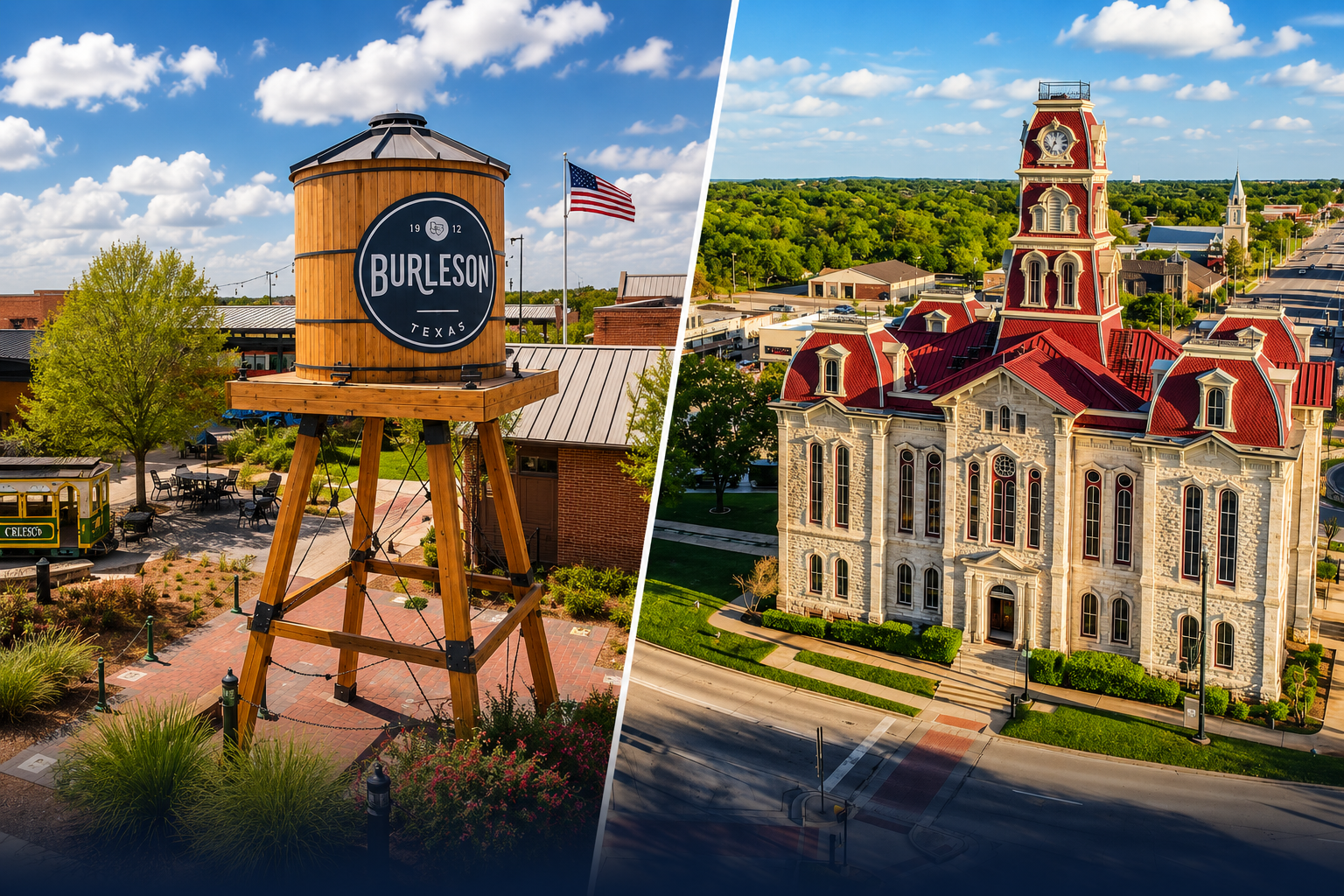
Relocating to North Texas means picking a community that fits your commute, your budget, and the lifestyle you're after. Burleson sits south of Fort Worth along a well-traveled corridor into the city, with median home values near $340,000 and one of the faster-growing suburban profiles in the region. Weatherford, the seat of Parker County, sits west of Fort Worth with a historic downtown character and generally lower home prices. Both are legitimate landing spots for relocating families, the right choice depends on which tradeoffs matter most to you.
Why North Texas Keeps Drawing Relocators
The numbers behind DFW's growth aren't hype. According to the City of Fort Worth's official population page, Fort Worth has been the fastest-growing large U.S. city (among the top 30 most populous) since 2020, with population growth of 11.9% over five years and approximately 2% in the most recent year reported as of its August 2026 update. A Dallas Fed Fort Worth Economic Indicators report from July 2026 adds that Fort Worth's population has grown an average of 2.2% per year over the prior 15 years, outpacing both its metro division and the broader DFW area.
The job market backs that growth up. The Fort Worth Report's July 2026 summary of a new local economic report found that Fort Worth employment grew at an annualized rate of 3.4% over the three months ending in May 2026, with monthly annualized rates between 1.6% and 2.6% in April and May. That's not a fluke, the Dallas Fed's DFW Economic Indicators tracked annualized DFW employment growth of 2.5% in August 2025 after a flat July, and the Dallas Regional Chamber's October 2025 Economy in Brief placed DFW 6th among large U.S. metros for year-over-year job growth. The region's employment base spans professional services, logistics, healthcare, education, defense, and energy, which means relocators aren't betting on a single industry.
I work with relocating families across Johnson County, Tarrant County, and Parker County every year. The question I hear most isn't "should I move to North Texas?", it's "which part is right for us?" That's where the real work starts.
Burleson: Southern Corridor, Strong Growth, Family-Oriented
Burleson sits primarily in Johnson County, with a portion extending into Tarrant County. It's a direct commuter corridor into Fort Worth, and its growth story is hard to ignore. According to MoveWithJG's Burleson profile, the city has seen roughly 25% population growth since the 2020 Census, including about 4% growth in 2023 alone. The median age is approximately 34.9 years, median household income was around $94,000 in 2023 (well above both Texas and U.S. medians), and the homeownership rate sits above 70%.
On the housing side, the most recent data available as of August 26, 2026 comes from a local guide referencing Zillow's Home Value Index, which measured a median sale price of approximately $340,650 in May 2026, down about 1.3% year-over-year. Median days to pending was 25 days, meaning homes were still moving in under a month at the median. For context, a MoveWithJG market report from July 2025 showed a median of $353,255 at that point, up 3.9% from the prior year, so values have moderated slightly from mid-2025 highs, which is actually good news for buyers relocating now.
Housing costs in Burleson have historically run roughly 10-15% below the national average, according to neighborhood analyses drawing on 2023-2025 data. That gap, combined with above-average incomes, is a big part of why the city keeps growing.
Weatherford: Western Corridor, Historic Character, Lower Price Points
Weatherford is a different kind of North Texas community. As the seat of Parker County, it sits west of Fort Worth along a major corridor, and it carries a distinct historic-downtown identity that Burleson doesn't have. If you want more land, a slower pace, and a town that feels like it has roots, Weatherford tends to resonate.
Compiled demographic profiles from Map AI's Weatherford data overview indicate population growth around 1.9% per year (based on multi-year ACS estimates through approximately 2024-2025) and median home prices in the mid-$200,000s, with median rents in the mid-$1,300s. These are approximate figures from pre-2026 datasets, not live 2026 numbers, but they frame the general positioning: Weatherford tends to come in more affordable than most closer-in DFW suburbs, including Burleson.
The tradeoff is commute direction and distance. Burleson is a south-to-north drive into Fort Worth; Weatherford is a west-to-east drive. Both are auto-oriented, as is most of North Texas. Exact commute times depend heavily on your workplace location and the time of day you're on the road, something worth testing before you commit to a neighborhood.
Side-by-Side: Burleson vs. Weatherford at a Glance
| Factor | Burleson | Weatherford |
|---|---|---|
| County | Primarily Johnson County (part Tarrant) | Parker County |
| Direction from Fort Worth | South | West |
| Recent median home price | ~$340,650 (May 2026, Zillow HVI) | Mid-$200,000s (approx., pre-2026 ACS data) |
| Population growth pace | ~25% since 2020 Census | ~1.9% per year (multi-year ACS estimate) |
| Community character | Suburban, newer development, family-oriented | Exurban, historic downtown, more land |
| Commute style | South-to-north into Fort Worth | West-to-east into Fort Worth |
Every situation is different, and the only way to know which community actually fits is to run the specifics, your workplace, your budget, your priorities, with someone who knows both markets. That's exactly the kind of conversation I have with every relocating family before we ever look at a single listing.
How to Actually Execute Your North Texas Relocation
A smooth relocation comes down to sequencing. Here's how I walk my clients through it:
Step 1: Get Pre-Approved Before You Tour
If you're financing, your pre-approval letter is the foundation of everything else. It tells you what you can realistically shop for, and in a market where Burleson homes are going pending in 25 days at the median, you don't want to find your house and then spend a week chasing paperwork. Verify your numbers with your lender before you make a single trip.
Not sure where to start on what you can actually afford in this market? The post How Much House Can You Really Afford in North Texas? walks through the key factors specific to this region.
Step 2: Narrow Your Geography Before You Narrow Your Search
Don't start with Zillow. Start with a map and your commute. Burleson and Weatherford are both solid communities, but they're in different directions from Fort Worth, serve different parts of the job market, and have meaningfully different price points. Figure out which corridor works for your daily life first, then start filtering by price and property type.
If new construction is on your radar, it's worth understanding how that process works in North Texas specifically. The post New Construction in Godley TX: What Buyers Need to Know covers the key differences from a resale purchase.
Step 3: Understand the Texas Purchase Process
Texas real estate has a few features that relocators from other states sometimes find unfamiliar. The purchase contract includes an option period, which gives buyers a defined window to conduct inspections and negotiate repairs or walk away. Not every inspection finding is a deal-breaker, in my experience, most issues are negotiable, and a good agent helps you decide what's worth pushing on and what isn't.
Closing in Texas is handled by a title company, which manages the title search, escrow of funds, and closing coordination. Your lender, your agent, and the title company all work together through that final stretch. Understanding who does what, and when, keeps the process from feeling chaotic.
For a fuller picture of the buying process specific to Johnson and Tarrant counties, the post Buying a Home in Johnson and Tarrant County in 2026 is worth a read before you start touring.
Step 4: Plan Your Transition Logistics
A few practical items that come up for every relocating family I work with:
- Texas driver's license and vehicle registration: The Texas Department of Public Safety requires new residents to obtain a Texas license within 90 days of establishing residency. Vehicle registration transfers through your local county tax assessor-collector office.
- Voter registration: Update your registration through the Texas Secretary of State's office once you have a Texas address.
- Homestead exemption: If you're buying a primary residence, file for your homestead exemption with your county appraisal district. In Johnson County, that's the Johnson County Appraisal District; in Parker County, it's the Parker County Appraisal District. This exemption reduces your taxable value and is one of the most straightforward ways to manage your property tax bill going forward.
- Utilities and services: Texas has a deregulated electricity market, meaning you choose your provider. The Power to Choose portal (the official state comparison tool) lets you compare plans by ZIP code before you move in.
- School enrollment: Contact your specific district directly once you have a confirmed address. School boundaries in growing suburban communities can shift as new developments open, so don't rely on a map from two years ago.
Your specific situation, timeline, budget, whether you're selling a home elsewhere, whether you're buying or renting first, shapes which of these steps happen in what order. That's where a local agent who knows Johnson County, Parker County, and the Fort Worth corridor makes a real difference.
If you'd like to see what's available right now across Burleson, Weatherford, and the surrounding communities, you can start your home search here.
I'd also invite you to read what past clients have said about working with our team: Google, Zillow, and Realtor.com.
Frequently Asked Questions
Is Burleson or Weatherford better if I work in Fort Worth and want a small-town feel?
Both offer a smaller-city feel with access to Fort Worth, but they're different in character. Burleson is a faster-growing southern suburb with newer development and a suburban energy; Weatherford is a western exurb with a historic downtown and more of a rural-adjacent pace. If you want newer subdivisions and a shorter drive south of the city, Burleson fits. If you want more land, older character, and a west-of-Fort-Worth lifestyle, Weatherford tends to resonate. The commute direction matters too, so test-drive both before you decide.
How do Burleson and Weatherford home prices compare to other Fort Worth suburbs?
As of the most recent data available, Burleson's median home value was approximately $340,650 in May 2026 (per Zillow's Home Value Index), placing it in a mid-range position relative to DFW suburbs. Weatherford's median has historically tracked in the mid-$200,000s based on pre-2026 ACS-derived data, making it one of the more affordable options in the Fort Worth orbit. Both communities have historically priced below many inner-ring DFW suburbs, and Burleson's housing costs have been estimated at roughly 10-15% below the national average. For a current comparison tied to your specific price range, a local market analysis gives you a much clearer picture than any published benchmark.
What job opportunities are there in Fort Worth and North Texas for someone relocating to Burleson or Weatherford?
The DFW region's job base is genuinely diverse: professional services, logistics, healthcare, education, defense, and energy-adjacent industries all have significant presence. According to the Dallas Fed's July 2026 Fort Worth Economic Indicators report, Fort Worth employment grew at an annualized 3.4% over the three months ending in May 2026. The Dallas Regional Chamber's October 2025 Economy in Brief ranked DFW 6th among large U.S. metros for year-over-year job growth as of August 2025. Relocators to Burleson and Weatherford are tapping into that broader Fort Worth and DFW job market, with commute times that are manageable for most of the major employment corridors.
Are Burleson and Weatherford still growing, or has the housing market cooled off?
Both communities are still growing, though the pace of home price appreciation has moderated from 2021-2022 peaks. Burleson's median home value was down approximately 1.3% year-over-year as of May 2026 (Zillow HVI), after a period of stronger gains. Homes were still going pending in about 25 days at the median, which indicates an active market, not a stalled one. Weatherford's growth has been steadier and somewhat slower than Burleson's. The broader Fort Worth population has continued growing at roughly 2% annually per the city's most recent official figures. Cooling appreciation is generally better news for buyers than it is bad news for the market overall.
What should I know about schools if I relocate to Burleson or Weatherford?
Both Burleson and Weatherford have their own independent school districts serving the majority of their respective communities. Because both areas are actively developing, school boundaries and campus assignments can change as new subdivisions come online. I always tell relocating families to contact the specific district directly with their prospective address before making any assumptions about which campus their kids would attend. Your real estate agent can also help you confirm boundaries during the home search process, since this detail can legitimately affect which neighborhoods make the shortlist.
Equal Housing Opportunity. Jason Cech, Broker Associate, Fathom Realty, licensed by the Texas Real Estate Commission (TREC). This article is general information only and does not constitute legal, tax, or financial advice. Confirm your specific numbers with your title company, tax advisor, or lender. TREC: Information About Brokerage Services | TREC: Consumer Protection Notice.