
Can I Build a Second Home, Guest House, or Shop on My Acreage in Johnson County, Texas?
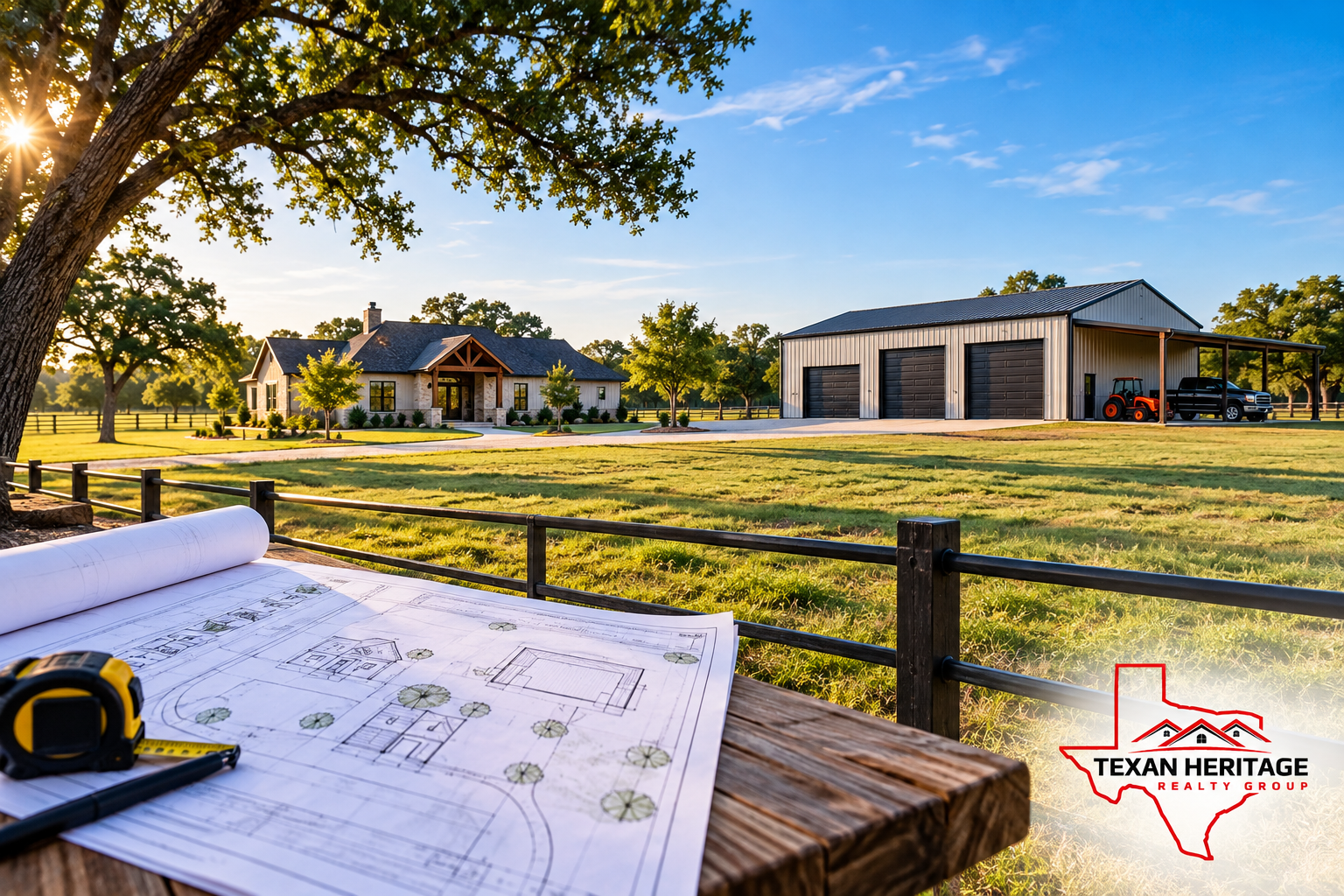
By Jason Cech, Broker Associate | Texan Heritage Realty Group, Fathom Realty
Updated October 2026
Quick Answer: Maybe—but owning acreage in Johnson County does not automatically mean you can build anything you want anywhere on the property. Before buying land with plans for a second home, guest house, workshop, barn, or other improvement, investigate deed restrictions, zoning or municipal/ETJ requirements where applicable, subdivision restrictions, easements, setbacks, floodplain and drainage issues, septic capacity, water availability, utilities, access, and permitting requirements. The best time to answer those questions is before your contractual due-diligence rights expire, not after closing.
One of the most expensive assumptions an acreage buyer can make is:
It's five acres. Surely I can build whatever I want.
Maybe.
But acreage and unrestricted acreage are not the same thing.
And even genuinely unrestricted land can have physical, utility, septic, floodplain, access, and governmental limitations that affect what you can actually build.
What Should I Check Before Buying Acreage for a Future Shop or Second Home?
Start with your intended use.
Don't simply tell your Realtor:
We want some land.
Tell us:
We want five acres where we can eventually build a 40-by-60 shop with electricity and plumbing.
Or:
My parents may eventually build a second house on the property.
Or:
We want an RV hookup and possibly a guest house.
Those are very different searches.
The more specific we are before you buy, the better we can investigate whether a property fits what you're actually trying to accomplish.
What can affect my plans?
| Issue | Why It Matters |
|---|---|
| Deed restrictions | May restrict additional dwellings, structures, livestock, commercial use, RVs, or building characteristics |
| Zoning | Properties inside municipalities can have specific permitted uses and development standards |
| ETJ/local regulations | Location outside city limits does not necessarily eliminate every governmental development requirement |
| Easements | Can restrict where improvements can be located |
| Septic | Additional bedrooms/plumbing may require additional or modified wastewater capacity |
| Private well | Water availability and system capacity matter |
| Public utilities | Extension or connection costs can materially affect a project |
| Floodplain/drainage | Can affect placement and development requirements |
| Access | A future second residence may create access questions |
| Survey | Shows boundaries, easements, and existing improvements |
| Subdivision/platting | Dividing property or creating separate homesites can introduce additional requirements |
That is why acreage due diligence needs to go much further than simply walking the property and deciding you like the view.
Can I Build a Shop on My Johnson County Acreage?
Potentially.
But first define shop.
A detached workshop used by the homeowner is different from a commercial operation with employees, customer traffic, heavy equipment, signage, or outside storage.
If you're considering a property within the City of Cleburne, for example, the city maintains zoning and subdivision ordinances and publishes development processes and residential accessory-building guidance. Cleburne
For properties elsewhere in Johnson County, the rules can differ depending on the exact location.
This is why the correct question isn't:
Does Johnson County allow shops?
It is:
Can I build the specific shop I want on this specific property in this specific location?
That's the question we investigate.
Can I Build a Second House on My Acreage?
Possibly, but don't assume acreage automatically equals multiple residences.
We may need to investigate:
- Existing deed restrictions
- Applicable zoning
- Lot or tract configuration
- Access
- Utility availability
- Septic requirements
- Well or water capacity
- Floodplain
- Applicable development rules
- Whether dividing the property is contemplated
- Whether the proposed second dwelling is treated differently from an accessory structure
There is also an important distinction between:
One tract with two residences
and
Dividing one tract into two separately conveyable homesites.
Those are not necessarily the same development question.
If your long-term goal is giving an acre to one of your children so they can build next door, tell us before you buy the property.
That future plan should be part of today's due diligence.
What About a Guest House or Mother-in-Law Suite?
Again, terminology matters.
A room over a detached garage, a small guest cottage without a kitchen, and a completely independent second dwelling may be treated differently depending on the jurisdiction and restrictions.
Don't rely on what the seller calls it.
Determine how the applicable authorities and recorded documents treat what you actually intend to build.
Why Does the Survey Matter?
This is exactly why our article Should I Get a Survey Before Buying Acreage in Johnson County, Texas? belongs in this acreage series.
A survey can help identify:
- Property boundaries
- Recorded easements shown on the survey
- Existing improvements
- Encroachments
- Access-related features
- Where improvements sit relative to boundaries
Suppose you find the perfect spot for your future shop.
Then the survey shows an easement running directly through it.
That's information I'd much rather have before closing.
How Can Septic Affect a Future Second Home or Shop?
Significantly.
A workshop without plumbing presents a different wastewater question from a second residence containing bedrooms, bathrooms, a kitchen, and laundry.
If the property relies on an on-site sewage facility, your future development plans should be discussed with the appropriate qualified OSSF professional and permitting authority.
This is why we should internally link directly to our septic-system acreage guide.
Don't assume:
There's already septic, so we're good.
The existing system was designed around a particular use and capacity.
Your proposed use may be different.
What If the Property Has a Private Well?
Same principle.
A well currently serving one residence does not automatically answer whether the water system meets your plans for a second residence, irrigation, livestock, shop, or other expanded use.
Texas Water Development Board explains that groundwater conservation districts may impose rules involving well registration, permitting, spacing, and groundwater production depending on the location. Texas Water Development Board
That's why our private-well article—the next blog in this package—is an important companion page.
What If the Listing Says “No Restrictions”?
Treat that as the beginning of the investigation, not the end.
We should still review title information and applicable recorded documents.
And even if we confirm there are no private deed restrictions affecting your proposed use, that does not make easements, septic, floodplain, utilities, access, or applicable governmental requirements disappear.
Unrestricted does not mean consequence-free.
That's an important distinction for rural buyers.
Should I Investigate All of This During the Option Period?
For an improved residential property using a TREC resale contract with a negotiated termination option, the option period can be critically important.
TREC explains that a negotiated option gives the buyer an unrestricted right to terminate during the agreed period and can be used to inspect and investigate the property. TREC
Different property types and contracts can require different due-diligence strategies.
The important part is establishing the applicable contractual deadlines at the beginning of the transaction and investigating your intended use while you still have relevant contractual rights.
Do not wait until two days after closing to call the county and say:
Okay, where can I put my 3,000-square-foot shop?
That's a very expensive time to discover a problem.
What Is Our Acreage Due-Diligence Checklist?
For a Johnson County acreage buyer planning future improvements, I want to investigate:
- Exact intended use.
- Survey and boundaries.
- Title commitment and recorded restrictions/easements.
- Applicable zoning and development rules.
- Floodplain and drainage.
- Septic type, location, capacity, and future needs.
- Water source and future demand.
- Electric and other utilities.
- Physical and legal access.
- Future structures.
- Potential subdivision plans.
- Agricultural appraisal implications, when applicable.
Not every property requires every specialist.
But the intended use determines which questions need answers.
Looking for Johnson County Acreage?
This is one of the reasons buying acreage is different from buying a house in a typical subdivision.
If you're searching around Cleburne, Godley, Joshua, Grandview, Alvarado, or elsewhere in Johnson County, tell the Texan Heritage Realty Group Team not just what you want to buy—but what you eventually want to do with it.
We can build the property search and due-diligence strategy around that goal.
Frequently Asked Questions
Can I build whatever I want if my property is outside city limits?
No. Being outside municipal limits does not automatically eliminate recorded restrictions, easements, subdivision requirements, septic rules, floodplain considerations, groundwater rules, or every applicable governmental requirement.
Can I put two houses on five acres in Johnson County?
Possibly, but acreage alone does not answer the question. The property's exact location, restrictions, access, utilities, septic, water, development rules, and proposed configuration need to be investigated.
Can I build a barndominium?
Potentially. Again, verify that the particular property and intended structure satisfy applicable restrictions, permitting, septic, utility, access, and other requirements.
Can I put an RV hookup on my acreage?
Possibly. Determine whether restrictions and applicable regulations allow the intended use and investigate septic, water, and electrical requirements.
Can I subdivide my acreage later?
Maybe. Don't purchase based on that assumption. If future division is part of your investment plan, investigate subdivision and access requirements before buying.
Does “no HOA” mean there are no deed restrictions?
No. A property can have recorded restrictions without an active homeowners association.
About Jason Cech
Jason Cech is a Broker Associate with Fathom Realty and team leader of Texan Heritage Realty Group. He has approximately a decade of real estate experience and more than 550 personal closings, serving Johnson County and surrounding North Texas communities.
Buying land for what you want to do tomorrow? Reach out to Texan Heritage Realty Group before deciding which property to buy today.
Texan Heritage Realty Group is affiliated with Fathom Realty. This article provides general real estate information and is not legal, engineering, surveying, environmental, OSSF, groundwater, zoning, or development advice. Requirements vary by property and jurisdiction. Consult the applicable governmental authorities and qualified professionals concerning a specific property. TREC regulates Texas real estate license holders. Equal Housing Opportunity.