
Do I Need a New Survey When Buying a House in Texas?
Maybe—but not every Texas home purchase requires a brand-new survey.
A seller may already have an existing survey that can potentially be used in the transaction. In other cases, the buyer may obtain a new one. Whether an existing survey is acceptable can depend on the contract, changes to the property, the title company, lender requirements, and the accuracy of the existing survey.
For buyers in Johnson County and surrounding North Texas communities—especially when purchasing acreage—the survey can be one of the most important documents in the transaction.
What Does a Property Survey Show?
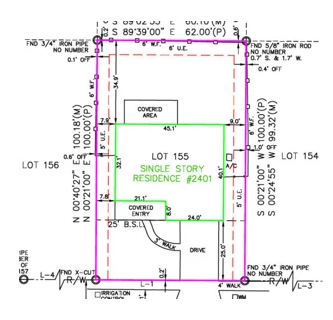
A residential survey generally depicts the property boundaries and improvements in relation to those boundaries.
Depending on the property and survey, it may identify things such as:
| Survey Item | Why a Buyer Should Care |
|---|---|
| Property boundaries | Shows the surveyed limits of the property |
| House/improvements | Shows their relationship to boundary lines |
| Easements | May affect where or how property can be used |
| Fences | May reveal that a fence and surveyed boundary differ |
| Building lines | Can affect future improvements |
| Encroachments | May identify improvements crossing certain lines |
| Other improvements | Pools, shops, garages, sheds, etc., when reflected |
For a typical subdivision home, the survey might look relatively straightforward.
On five or ten acres outside Cleburne or Godley, however, access easements, fences, barns, shops, pipelines, utilities, and other matters can make understanding the property much more important.
Can We Use the Seller’s Existing Survey?
Potentially.
Current TREC contract language provides a mechanism for a seller to furnish an existing survey along with the applicable affidavit or declaration. TREC revised its forms to allow use of the T-47.1 Declaration, which does not require notarization, as an alternative to the T-47 affidavit in applicable situations.
But possessing an old survey does not automatically mean it will be acceptable.
If significant improvements have been added since the survey was completed—or the survey otherwise does not accurately depict the property—a new survey may be necessary or advisable.
Who Pays for the Survey?
This is a contract question, not a universal Texas rule that one side always pays.
The parties negotiate the applicable provisions of the sales contract.
That is one reason we discuss survey issues while structuring the offer instead of waiting until the title company asks about them later.
Why Does the Survey Matter So Much on Acreage?
Suppose you're buying five acres outside Godley.
There's a beautiful shop at the back of the property, a fence running along one side, and a gravel driveway that appears to lead directly to the county road.
Those things may look perfectly normal during a showing.
But you still want to understand:
Where are the actual boundaries?
Does the driveway cross another tract?
Is there a recorded access easement?
Where are utility easements located?
Does the fence follow the surveyed property line?
This is why rural-property due diligence is different from simply walking through the house and deciding whether you like the kitchen.
What Changed in the Texas Contract?
TREC updated Paragraph 6C beginning with the 2025 contract revisions. Among other changes, the contract language recognizes the T-47.1 Declaration and changed provisions concerning a buyer obtaining a new survey.
TREC subsequently adopted another generation of contract forms effective July 1, 2026, including the current One to Four Family Residential Contract (Resale), Form 20-19.
That date matters because buyers and sellers searching online can easily find articles discussing older versions of Texas contracts.
A Survey and a Title Policy Are Not the Same Thing
These documents serve different purposes.
A survey physically depicts relevant aspects of the property. A title commitment identifies matters affecting title, subject to its terms, exceptions, and requirements. A title insurance policy provides contractual title coverage according to the policy.
Texas title insurance premiums are regulated by the Texas Department of Insurance. New basic premium rates became effective March 1, 2026.
Buyers should review both the survey and title information rather than assuming one makes the other unnecessary.
Buying a Home or Acreage in North Texas?
A house can look perfect while the documents tell you something you would never notice during a showing.
Our job isn't simply to find you a property. It is to help you work through the contract, title, survey, inspection, appraisal, financing, and closing process so you understand what you're buying.
Search North Texas homes with Texan Heritage Realty Group
Frequently Asked Questions
How old can a Texas survey be?
There is not a simple universal rule that a residential survey becomes unusable merely because it reaches a certain age. Its acceptability depends on the circumstances, including whether it still accurately depicts the property and whether it satisfies applicable transaction, title, and lender requirements.
If the seller has a survey, do I automatically have to accept it?
No. The applicable contract provisions, survey condition, title requirements, financing, and negotiated terms all matter.
What if a fence isn't on the property line?
Don't automatically assume that a fence establishes legal ownership. Review the survey and title information and seek appropriate professional or legal guidance if a boundary issue exists.
Should I get a new survey when buying acreage?
Acreage often presents more boundary, access, easement, fence, and improvement questions than a typical subdivision lot. Whether a new survey is necessary depends on the specific property, but it deserves careful attention.
Does a survey tell me whether I can build a shop or pool?
Not by itself. Easements, setbacks, deed restrictions, HOA restrictions, zoning or municipal rules, septic requirements, and other limitations may also matter.
Who should interpret a complicated boundary dispute?
A real estate agent can help identify issues in a transaction, but legal boundary disputes and interpretation of property rights should be handled by an attorney and, where appropriate, a licensed survey professional.
Before You Buy, Understand What Comes With the Property
The house is only part of what you're buying.
Texan Heritage Realty Group represents buyers throughout Johnson County and surrounding North Texas communities, including residential, new-construction, rural, and acreage transactions.
Start your North Texas home search
About Jason Cech
Jason Cech is a Broker Associate with Fathom Realty and team leader of Texan Heritage Realty Group. With approximately a decade in the business and more than 550 personal closings, Jason and his team help buyers navigate both traditional residential purchases and the additional due diligence that often accompanies North Texas acreage and rural property.
Integrity. Tradition. Excellence.
Texan Heritage Realty Group is affiliated with Fathom Realty. This article is general educational information and is not legal, surveying, title, lending, engineering, or tax advice. Contract requirements and property circumstances vary. Consult the appropriate professional regarding your transaction. Equal Housing Opportunity.