
Should I Get a Survey Before Buying Acreage in Johnson County, Texas?
By Jason Cech, Broker Associate | Texan Heritage Realty Group, Fathom Realty
Updated September 2026
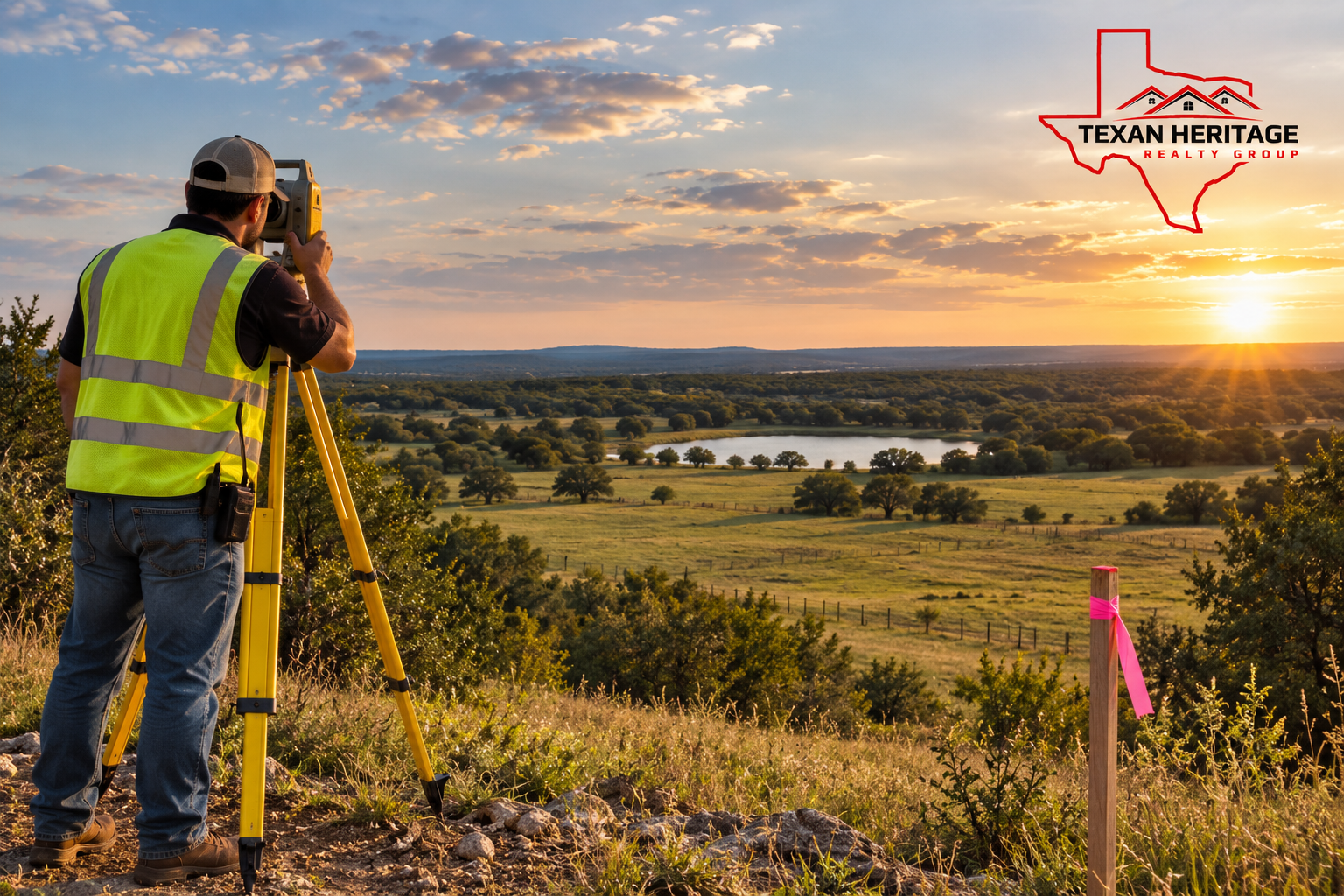
Quick Answer: When buying acreage in Johnson County, Texas, a current survey can be one of the most important pieces of your due diligence. A survey can help identify the property's boundaries, improvements, easements, encroachments, access issues, and other matters that may not be obvious when you walk the land. An existing survey may sometimes be acceptable to the title company and lender, but acreage buyers should not assume an old survey is adequate simply because one exists.
Buying five or ten acres isn't quite the same as buying Lot 12, Block 4 in a subdivision.
When you're buying acreage around Cleburne, Godley, Joshua, Grandview, Alvarado, Rio Vista, or elsewhere in Johnson County, you're not just buying a house.
You're buying the dirt.
And before you own that dirt, you need to understand exactly what you're buying.
What does a property survey actually tell a Texas buyer?
A real property survey is prepared by a registered professional land surveyor and depicts the property and certain physical and boundary-related conditions.
Depending on the survey and property, it may help identify things such as:
- Boundary lines and dimensions.
- Location of the home and other improvements.
- Fences relative to surveyed boundaries.
- Easements.
- Encroachments.
- Roads and access.
- Buildings, barns, shops, or other improvements.
- Other conditions relevant to the surveyed property.
That's especially important with acreage because what you see on the ground isn't necessarily the legal boundary.
That fence that's been there for 40 years?
It may follow the property line.
It may also follow where somebody's grandfather decided a fence was convenient 40 years ago.
Those are not necessarily the same thing.
Do I need a new survey if the seller already has one?
Not always.
Under the current TREC resale contract, the parties can select among several survey arrangements. One allows the seller to furnish an existing survey along with the applicable Texas Department of Insurance residential real property affidavit or declaration. If the title company or buyer's lender doesn't accept the existing survey or related affidavit/declaration, the contract addresses obtaining a new survey and which party will pay based on the selections made in the contract.
Texas title-insurance rules also allow a title company, under certain circumstances, to accept an existing survey for residential real property. Importantly, the title company must find the survey acceptable.
So the right question isn't:
Is there already a survey?
It's:
Is the existing survey current enough, accurate enough, and acceptable for this transaction?
When would I seriously consider getting a new survey?
There are several situations where an acreage buyer should give a new survey serious consideration.
| Situation | Why It Matters |
|---|---|
| Improvements were added after the old survey | Barns, shops, pools, additions, fences, or other improvements may not appear |
| Fence locations are important | A fence isn't proof of the legal boundary |
| Access is questionable | You need to understand how the property legally connects to a public road |
| Acreage amount matters | You want clarity about the tract being purchased |
| Easements cross the property | They could affect future use |
| Buyer plans additional improvements | Location of boundaries/easements may affect where improvements can go |
| Property has been divided or combined | An older survey may not depict the current configuration |
| Title company or lender rejects the existing survey | A new survey may become necessary under the transaction documents |
For acreage, I would rather discover a problem while we still have an opportunity to investigate it than after the buyer owns the property.
Is a fence the same thing as the property line?
No.
This deserves its own section because it comes up constantly with acreage.
A fence is a physical improvement.
A boundary is a surveyed/legal matter.
Sometimes they line up beautifully.
Sometimes they don't.
If you're buying land because you need a certain amount of fenced pasture, want to construct a shop, intend to build another home, or simply want to know where your property ends and the neighbor's begins, don't assume the fence answers that question.
What about easements?
This is where the survey and title commitment should be reviewed together.
A title commitment may identify recorded easements and other exceptions affecting the property. A survey can help show the physical relationship of certain matters to the land.
For example, imagine you've found the perfect five-acre property outside Godley.
You already know exactly where your 40-by-60 shop is going.
Then you discover there's an easement running directly through that part of the property.
That's something I'd prefer to learn before you pour concrete.
The current TREC resale contract provides a mechanism for buyers to make timely objections to certain defects, exceptions, or encumbrances disclosed by the survey or title commitment, subject to the specific terms and deadlines written into the contract.
Those deadlines matter.
Does a survey tell me whether I can use the property however I want?
No.
This is another big acreage misconception.
A survey is only one part of rural-property due diligence.
Depending on the property and your intended use, we may also need to investigate:
Restrictions: Are there deed restrictions affecting what you can build or how you can use the property?
Access: Is there legal and practical access?
Utilities: Where are electric and other available utilities located?
Water: Is there a well, rural water provider, or another source?
Septic: What system serves the property, and what do we know about it?
Flood/drainage: Are portions of the property affected?
Minerals: What rights have previously been reserved or conveyed?
Agricultural use: Does the property currently receive agricultural/open-space special appraisal, and does the buyer's intended use fit with continuing qualification?
Future improvements: Can the buyer realistically build the shop, barn, second residence, arena, or other improvement they envision?
This is why I tell acreage buyers:
Don't just investigate the house. Investigate the dirt.
Should I order a survey before or after making an offer?
Usually, survey obligations are addressed in the contract itself.
The current TREC resale contract contains specific selections for an existing survey, a buyer-obtained survey, or a seller-obtained new survey, including deadlines and expense allocations.
That means the survey conversation should happen while we're preparing the offer, not two weeks later when someone suddenly remembers we need one.
Your intended use matters, too.
If you tell me you're buying five acres because you want:
- A 3,000-square-foot shop.
- Horses.
- RV storage.
- A second residence.
- A business operation.
- Future subdivision potential.
...those goals change the questions we should be asking before closing.
Why is a survey especially important when buying Johnson County acreage?
Johnson County offers a wide variety of properties.
You can go from a residential neighborhood in Cleburne to larger tracts around Godley, Joshua, Grandview, Rio Vista, Venus, or Alvarado surprisingly quickly.
With rural and acreage property, there can be more moving parts than with a typical subdivision transaction.
The survey is one piece of the larger picture.
At Texan Heritage Realty Group, we want to know why you're buying the acreage, because that helps determine what needs to be investigated.
A beautiful property isn't much help if it can't reasonably accommodate the reason you bought it.
Thinking about buying acreage in Johnson County?
Start your search with the Texan Heritage Realty Group team before you fall in love with a property based solely on the house, trees, or acreage number.
We help buyers throughout Cleburne, Godley, Joshua, Grandview, Alvarado, and surrounding North Texas communities evaluate the entire property—not just what's inside the front door.
Frequently Asked Questions
Does the seller have to pay for a new survey in Texas?
Not automatically. The TREC contract contains selections addressing whether an existing survey will be provided or a new survey obtained and who bears the expense in various circumstances. Read the completed contract rather than assuming the buyer or seller always pays.
Can the title company accept an old survey?
Potentially. Texas title-insurance rules permit title companies to accept existing surveys in qualifying circumstances, but the survey must be acceptable to the title company.
Does the survey show easements?
A survey can depict relevant easement information, but buyers should review the survey together with the title commitment and exception documents rather than relying on one document alone.
Does a survey prove that I can build a shop?
No. A survey can provide critical information about the property, but restrictions, easements, setbacks, permitting requirements, utilities, septic requirements, and other issues may affect a proposed improvement.
Should I survey acreage if I'm paying cash?
Paying cash eliminates a lender from the transaction; it doesn't eliminate boundary, easement, encroachment, or access concerns. Whether a new survey makes sense depends on the property and transaction.
The Bottom Line
When you're buying acreage in Johnson County, don't assume the fence is the boundary, the old survey is good enough, or five acres automatically means you can do whatever you want with five acres.
Understand what you're buying.
A survey, title commitment, property inspection, and appropriate rural-property due diligence can answer very different questions—and together they can help you make a much more informed purchase.
Ready to start looking for acreage? Contact the Texan Heritage Realty Group team and tell us what you actually want to do with the property. That's where the search should begin.
About Jason Cech
Jason Cech is a Broker Associate with Fathom Realty and team leader of Texan Heritage Realty Group. Licensed since 2017, Jason has personally closed more than 550 real estate transactions and works with residential, acreage, land, and farm-and-ranch clients throughout Johnson County and surrounding North Texas communities.
Disclaimer: Texan Heritage Realty Group is powered by Fathom Realty. This article is for general educational purposes and is not legal, surveying, title, engineering, tax, lending, or land-use advice. Contract rights depend on the executed agreement and circumstances. Consult a Texas real estate attorney, registered professional land surveyor, title company, lender, governmental authority, or other qualified professional when appropriate. TREC notices should be provided as required. Equal Housing Opportunity.