
What Should I Check Before Buying a Johnson County Property With a Private Water Well?
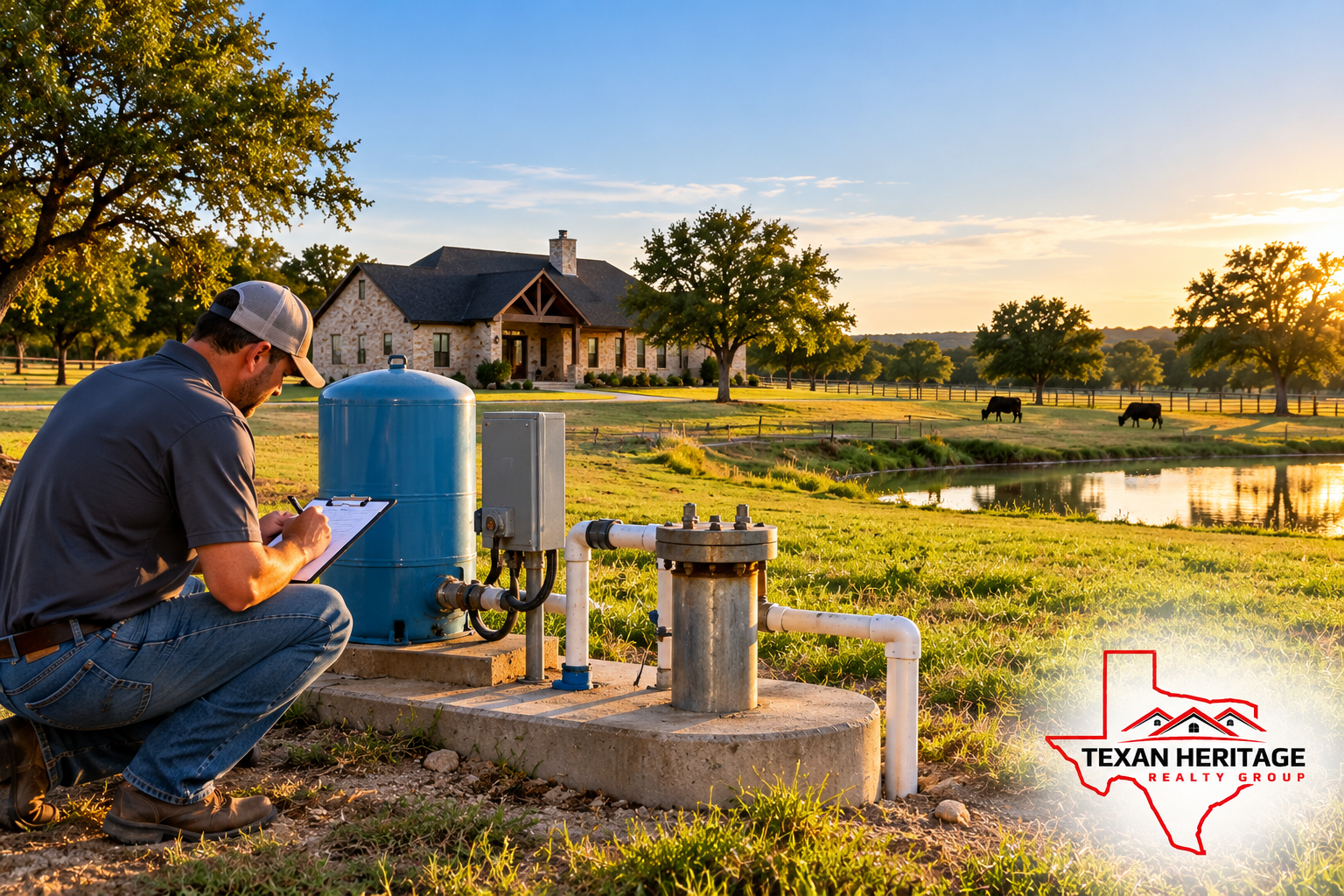
By Jason Cech, Broker Associate | Texan Heritage Realty Group, Fathom Realty
Updated October 2026
Quick Answer: Before buying a Johnson County property with a private water well, identify the well, locate its drilling report when available, determine its approximate age and depth, have the water appropriately tested, evaluate the well equipment and performance, identify any groundwater-conservation-district requirements, and make sure the system reasonably fits your intended use. Texas does not regulate private-well water quality the same way it regulates public drinking-water systems; responsibility for monitoring private-well water rests with the well owner. Texas Water Development Board
If you've always lived on city water, turning on a faucet is pretty simple.
Water comes out.
You pay the bill.
You generally don't spend much time thinking about where it came from.
Buying acreage with a private well changes that.
Is Buying a Home With a Private Well a Bad Idea?
No.
Private wells are common on rural Texas properties.
But ownership comes with additional responsibility.
TCEQ states that a private-well owner is responsible for regularly testing the water to ensure it is safe for drinking and cooking and recommends using an accredited drinking-water laboratory. TCEQ
TWDB likewise explains that Texas does not regulate private-well water quality and that owners are responsible for addressing water-quality problems. Texas Water Development Board
So the right question isn't:
Should I be afraid of a well?
It's:
What do we know about this particular well?
What Should I Ask About the Well?
Start with its history.
| Question | Why We Care |
|---|---|
| When was it drilled? | Establishes approximate age |
| How deep is it? | Useful construction information |
| Who drilled it? | Can help identify records |
| Is the drilling report available? | Provides valuable well information |
| What does the well serve? | Household, livestock, irrigation, multiple structures |
| Has the pump been replaced? | Establishes equipment history |
| Has the well had production problems? | Important practical history |
| Has the water been tested? | Establishes recent quality information |
| Is treatment equipment installed? | May reveal known water-quality characteristics |
| Is there a groundwater district? | Local requirements may apply |
Can I Find the Original Texas Well Report?
Often.
TWDB maintains resources for locating water-well reports.
For wells drilled from 2003 forward, Texas well reports are generally stored electronically in the Submitted Drillers Reports database. Older records may be available through separate historical databases. Texas Water Development Board
Helpful search information includes the approximate drilling date, owner at the time the well was drilled, well depth, and drilling company.
If the seller says:
I don't know anything about the well. It's just always been there.
That doesn't necessarily end the investigation.
We may be able to find records.
Should I Test the Well Water Before Closing?
I strongly favor appropriate testing when a buyer will rely on a private well for drinking water.
TCEQ recommends using an accredited drinking-water laboratory. TCEQ
TWDB explains that testing can range from relatively basic bacteriological analysis to broader drinking-water analysis depending on the concerns and circumstances. Texas Water Development Board
What should be tested can depend on local conditions and the property.
The simple takeaway:
Clear water isn't the same thing as tested water.
And:
Tastes fine isn't a laboratory result.
How Do I Properly Collect a Water Sample?
Follow the laboratory's instructions.
TCEQ's private-well sampling guidance outlines a process that begins with selecting an accredited laboratory and obtaining the proper sterile container and sampling instructions. TCEQ
Improper sampling can compromise the usefulness of the result.
For a transaction, don't casually fill an old water bottle from the kitchen sink and assume you've conducted a meaningful water test.
Should I Have the Well Equipment Inspected Too?
Water quality and well performance are different questions.
Testing the water doesn't necessarily tell you the condition of:
- Pump
- Pressure tank
- Electrical equipment
- Wellhead
- Piping
- Controls
- Treatment equipment
Depending on the property, a qualified well professional may be appropriate.
I also want buyers thinking about demand.
A well that has successfully served a two-person household may raise different questions if your plan is to add another residence, extensive irrigation, livestock facilities, or other significant water uses.
That's exactly why Blog #1 and this article belong together.
Does a Texas Private Well Have to Be Registered?
Not necessarily with the state.
TWDB says private-well owners generally do not have to register a well unless the property falls within a groundwater conservation district that requires registration. Each groundwater district can have its own rules. Texas Water Development Board
Drillers and landowners who drill their own wells do have state well-reporting requirements for newly drilled wells. Texas Water Development Board
For a buyer, the practical step is:
Determine whether the property lies within a groundwater conservation district and then check that district's requirements.
Can I Pump as Much Water as I Want Because I Own the Land?
Don't assume so.
TWDB explains Texas's historic rule of capture but also notes important limitations and the authority of groundwater conservation districts to regulate groundwater production through tools such as permitting and well-spacing requirements. Texas Water Development Board
Most residential acreage buyers don't need to become groundwater-law experts.
They do need to understand the rules applying to the specific property they're buying.
What If I Want to Add Another House Later?
Then water becomes part of your development due diligence.
If you're buying acreage because you eventually want:
- Another residence
- Guest house
- Large shop
- Livestock
- Irrigation
- Pool
- Additional landscaping
tell us before closing.
The existing water system needs to be considered alongside your future demand and any applicable rules.
How Does the Well Fit Into the Rest of My Acreage Due Diligence?
Think of acreage as a system.
Survey: What exactly are you buying?
Title: What restrictions and easements affect it?
Septic: Where does wastewater go?
Well: Where does your water come from?
Access: Can you legally and physically reach it?
Utilities: What services are available?
Flood/drainage: Where does water go when it rains?
Ag appraisal: How is the land currently treated for property-tax appraisal?
Each answer affects the others.
That's how we want our Johnson County acreage content to work too: one comprehensive resource leading naturally into the next.
Buying a Johnson County Property With a Well?
Whether you're looking around Cleburne, Godley, Joshua, Grandview, Alvarado, or rural Johnson County, the Texan Heritage Realty Group Team can help you organize the property-specific due diligence before your contractual deadlines expire.
Frequently Asked Questions
Is private well water regulated like city water?
No. TCEQ says owners of private wells are responsible for regularly testing their water for drinking and cooking safety. TCEQ
Where do I find a Texas well report?
TWDB provides databases and instructions for locating Texas water-well reports, with different resources depending partly on when the well was drilled. Texas Water Development Board
Should I test a well even if the water looks clear?
Yes, appearance alone does not establish water quality. Appropriate laboratory testing provides actual information about the constituents included in the analysis.
Is a well report the same thing as a water test?
No. The well report provides information concerning the well itself. Water testing evaluates a water sample for whatever contaminants or characteristics are included in the selected analysis.
Can a well support two houses?
Maybe. Existing performance, well characteristics, water availability, equipment, anticipated demand, and applicable groundwater rules all deserve investigation.
Should I investigate the well during my option period?
When applicable to the contract, material property investigations should be performed early enough for the buyer to receive and evaluate the information while relevant contractual rights remain available.
About Jason Cech
Jason Cech is a Broker Associate with Fathom Realty and team leader of Texan Heritage Realty Group. He has approximately a decade of real estate experience and more than 550 personal closings, serving Johnson County and surrounding North Texas communities.
Looking at acreage with a private well? Contact Texan Heritage Realty Group before closing. Rural-property due diligence doesn't stop at the front door.
Texan Heritage Realty Group is affiliated with Fathom Realty. This article provides general real estate information and is not water-quality, environmental, engineering, groundwater, legal, or health advice. Consult accredited laboratories, qualified well professionals, applicable groundwater districts, TCEQ, TWDB, and other appropriate professionals concerning a specific property. TREC regulates Texas real estate license holders. Equal Housing Opportunity.