Why do you need mortgage pre-approval before touring homes in North Texas?

In North Texas, getting pre-approved before you tour homes is the single most important thing you can do to protect your time, your money, and your chances of landing the right house. Fort Worth's market is more balanced in 2026 than it was a few years ago, but homes in attractive price ranges still receive multiple offers, and listing agents routinely set aside offers that don't include a current lender pre-approval letter.
I always tell my clients this before we ever schedule a single showing: the pre-approval isn't paperwork for paperwork's sake. It's the foundation of your entire offer strategy.
What the 2026 Fort Worth Market Actually Looks Like
If you've been watching headlines, you know North Texas has cooled from its pandemic-era intensity. That's true. But "cooled" doesn't mean "easy."
According to the Greater Fort Worth Association of REALTORS® (GFWAR) June 2026 Housing Report, the year-to-date median home price in Fort Worth through the first half of 2026 was $333,068, with the June 2026 median sitting at $335,975, down just 0.3% from June 2025. Tarrant County's year-to-date median was $350,528, and Denton County ran higher at around $434,748. Prices vary meaningfully depending on where you're shopping.
A Fort Worth Report story from July 2026 summarizing the same GFWAR data noted that Q2 2026 saw 1,067 homes sold in June alone, up 5.2% year over year, even as prices softened slightly. That's not a slow market. That's a market with more options for buyers, and still enough demand that being unprepared costs you.
Mid-2026 estimates from Zillow (updated through June 30, 2026) put Fort Worth's median days to pending at around 28 days, with about 21% of homes still closing above list price. Redfin's August 2026 snapshot characterizes Fort Worth as "somewhat competitive," with homes averaging about 2 offers and selling in roughly 46 days. Those two sources use different datasets, so treat them as context rather than definitive figures, but the direction is clear: typical Fort Worth homes go under contract in about one to two months, and multiple offers remain common in well-priced ranges.
The bottom line: you have more negotiating room than buyers had in 2021 or 2022, but you still need to be ready to move when the right home appears.
| Area |
YTD Median Price (Jan–Jun 2026) |
Source |
| Fort Worth |
$333,068 |
GFWAR June 2026 Report |
| Tarrant County |
$350,528 |
GFWAR June 2026 Report |
| Denton County |
$434,748 |
GFWAR June 2026 Report |
Those price differences matter more than most buyers realize. If you're pre-approved based on a rough estimate of what you "think" you can afford, you may be touring homes in Denton County when your budget actually fits Fort Worth or Burleson. Pre-approval gives you a real number, not a guess. If you're still working through what those numbers mean for your situation, my post on how much house you can really afford in North Texas is a good place to start.
Pre-Qualification vs. Pre-Approval: The Difference That Wins (or Loses) Deals
These two terms get used interchangeably, but they are not the same thing, and sellers in North Texas know the difference.
Pre-qualification is informal. A lender takes your self-reported income, debts, and assets and gives you a ballpark number. No verification, no credit pull (or only a soft pull). It takes fifteen minutes and means almost nothing to a listing agent reviewing competing offers.
Pre-approval is a conditional commitment. The lender has pulled your credit, verified your income documents (W-2s, tax returns, pay stubs), reviewed your assets, and run your file through underwriting guidelines. You get a letter with a specific loan amount. That letter tells the seller's agent: this buyer has been vetted.
According to NAR's 2024 Profile of Home Buyers and Sellers, 4% of successful homebuyers had at least one mortgage application rejected before ultimately closing, with debt-to-income ratio problems cited in 40% of those cases and low credit scores in 23%. Pre-approval is how you find those problems before you're under contract and have already paid for inspections.
In a market where homes can go under contract in under a month, discovering a financing issue after you've written an offer is an expensive problem. You could lose your option fee, and depending on contract timing, potentially your earnest money too. Pre-approval shifts that risk to the beginning of the process, when the stakes are zero.
How Pre-Approval Fits the Texas Homebuying Process
Texas has a specific transaction sequence that makes pre-approval even more important than in some other states, and it's worth understanding before you start touring.
The TREC Contract and Buyer Approval Deadline
When you write an offer in Texas using the standard TREC One to Four Family Residential Contract, buyers using financing typically attach the Third Party Financing Addendum. That addendum sets a "Buyer Approval" deadline, a specific date by which you must obtain full loan approval. If you're starting the pre-approval process after you go under contract, you're already behind. Buyers who come in pre-approved have a much easier time meeting that deadline and are far less likely to need extensions that can frustrate sellers or put the contract at risk.
The Seller's Disclosure and Why Speed Matters
Under Texas Property Code § 5.008, sellers of most previously occupied single-family homes must provide a written Seller's Disclosure Notice detailing known material facts and property condition. As of July 1, 2026, TREC has mandatory updated forms in effect, including a revised Seller's Disclosure Notice and a new Water Notice (TREC No. 61-0). Always confirm the latest required forms directly with TREC or your agent.
That disclosure often reveals things worth knowing: foundation history, prior flooding, roof age, mechanical systems. A pre-approved buyer can review that disclosure and quickly ask their lender whether any issues would affect underwriting. A buyer who hasn't started the loan process yet has to pause, figure out financing, and then circle back. In a market where a well-priced home in Cleburne, Burleson, or Joshua can attract multiple buyers, that delay can cost you the house.
The Title Company's Role in Your Closing Timeline
Texas is a title company closing state. Your title company acts as escrow agent, holds your earnest money, orders the title commitment, coordinates with your lender to prepare the Closing Disclosure and loan documents, conducts the signing, and records the deed with the county clerk (Tarrant County Clerk, in most Fort Worth transactions).
Here's the key: the title company cannot finalize the closing until the lender delivers clear-to-close instructions. Pre-approval shortens that path because a significant portion of the underwriting work is done before you ever write an offer. Buyers who walk in fully pre-approved tend to have smoother, faster closings. That matters to sellers, and it matters to you.
For a broader look at what the local buying process involves in Tarrant and Johnson Counties, my guide on buying a home in Johnson and Tarrant County in 2026 walks through the full sequence.
What Listing Agents in North Texas Actually Expect
Texas law doesn't require you to attach a pre-approval letter to an offer. But in practice, listing agents across Fort Worth, Weatherford, Aledo, and the surrounding communities expect one. In competitive price ranges, offers without a current lender letter are often set aside in favor of similarly priced offers from pre-approved buyers. I've seen it happen. It's not a technicality. It's a real competitive disadvantage.
Your specific situation, your price range, your target neighborhoods, and your timeline all shape how much this matters. That's exactly the kind of question I walk buyers through before we ever schedule a showing.
If you've found this helpful, I'd appreciate you taking a moment to share your experience. You can read what other buyers and sellers have said on Google, Zillow, or Realtor.com.
Frequently Asked Questions
Do I really need a mortgage pre-approval before I start touring homes in Fort Worth?
Yes, and not just as a formality. In Fort Worth's 2026 market, homes in attractive price ranges still receive multiple offers and go under contract in weeks. Listing agents routinely expect a current pre-approval letter with any serious offer, and touring without one means you're not actually ready to buy, even if you find the right home tomorrow.
What's the difference between pre-qualification and pre-approval when buying a house in Texas?
Pre-qualification is an informal estimate based on self-reported information and carries little weight with sellers. Pre-approval involves verified income documents, a credit pull, and a conditional commitment from the lender for a specific loan amount. In North Texas, sellers and their agents treat full pre-approval as significantly stronger evidence that a buyer can actually close.
Will a seller in Fort Worth even look at my offer if I don't include a pre-approval letter?
They might glance at it, but in competitive price ranges they probably won't take it seriously. North Texas listing agents commonly require or strongly prefer a current lender pre-approval letter to consider an offer. An offer at the same price from a pre-approved buyer will almost always be chosen over one without documentation of financing.
How long does a pre-approval letter stay valid in North Texas before I need to update it?
Most lenders issue pre-approval letters that are valid for 60 to 90 days, though this varies by lender and loan type. If your search extends beyond that window, you'll need to refresh it, which typically means updated pay stubs and a credit review. Confirm the specific expiration with your lender, and don't let it lapse while you're actively touring.
If my pre-approval is denied, can I still buy a home in North Texas, and what should I fix first?
A denial is not the end of the road. According to NAR's 2024 Profile of Home Buyers and Sellers, the most common reasons for rejection are debt-to-income ratio issues (40%), low credit scores (23%), unverifiable income (12%), and insufficient reserves (12%). Each of those has a path forward. A good lender will tell you exactly what to address, and the earlier you find out, the more time you have to fix it before you're under contract on a home you love.
How fast do homes sell in Fort Worth right now, and how does pre-approval help me move quickly?
As of mid-2026, estimates from national portals suggest Fort Worth homes go pending in roughly 28 to 46 days depending on the data source, with some well-priced homes moving faster. Pre-approval means that when you find the right home, you can write a credible offer the same day, rather than scrambling to start the loan process after the fact.
Pre-approval isn't just a box to check. It's the step that makes every other step in the North Texas homebuying process faster, cleaner, and more competitive. If you're ready to get started, or just want to understand exactly what a lender will look at before you call one, reach out to me directly and I'll walk you through it.
About Jason Cech
Jason Cech is the Owner and Broker Associate of Texan Heritage Realty Group in Cleburne, Texas, with over 9 years of real estate experience helping families buy and sell across Johnson County, Fort Worth, and North Texas. A DFW Real Producers Top 500 Agent and multi-year top producer, he leads his team with a client-first approach built on integrity, tradition, and excellence.
Fathom Realty · 817-776-8319
Equal Housing Opportunity. Jason Cech, Broker Associate, Fathom Realty, licensed by the Texas Real Estate Commission (TREC). This article is general information only and is not legal, tax, or financial advice. Confirm your specific situation with your attorney, tax advisor, lender, or closing officer. Broker fees and commissions are fully negotiable and not set by law. TREC: Information About Brokerage Services | TREC: Consumer Protection Notice.
Jan. 29, 2026
Will 2026 Be a Strong Year for Real Estate? What Today’s Mortgage-Rate Volatility Really Means
Q: Will 2026 be a strong year for real estate even with all the rate and policy headlines?
A: Yes—despite short‑term volatility from policy moves and global headlines, leading forecasts point to more inventory, steady‑to‑slightly‑lower mortgage rates than 2025, and higher home sales in 2026. Here’s what that means for you.
The Quick Context: Why Rates Whipsawed to Start the Year
The first weeks of 2026 delivered a pile‑up of news that moved mortgage markets:
-
A federal directive for the GSEs to buy up to $200B in mortgage‑backed securities (MBS) briefly pushed mortgage rates to a three‑year low before markets reassessed.
-
Geopolitical noise—including tariff threats tied to debates over Greenland—nudged Treasury yields higher, which pulled mortgage rates back up.
-
Even with the bump, average 30‑year rates in mid‑January remained well below most of 2025’s peaks.
Bottom line: Near‑term headlines can swing day‑to‑day rates, but the larger 2026 backdrop still points toward a more active housing year than 2025.
What This Means If You’re Planning to Buy in 2026
-
Affordability is improving at the margins. Rates are lower than much of last year, and sellers are more realistic on pricing as inventory slowly rebuilds.
-
New construction can stretch your budget further. Builders continue to offer rate buydowns and closing‑cost credits—ask about permanent buydowns and price‑protected delivery windows.
-
Lock smart. Consider a float‑down option with your lender. If rates improve before closing, you capture the drop; if they rise, you’re protected.
-
ARMs vs. fixed: Adjustable‑rate mortgages are back in the conversation. Make sure the reset math works for your time horizon and budget.
Buyer To‑Do List
-
Get fully underwritten pre‑approval (not just pre‑qualification).
-
Price‑shop three lenders on the same day; compare APRs, points, and credits.
-
Ask about temporary (2‑1/1‑0) buydowns vs. permanent buydowns; run both scenarios.
-
Build a cushion for taxes/insurance—escrows are adjusting up in many markets.
What This Means If You’re Planning to Sell in 2026
-
Demand is set to rise. Several forecasts call for higher transaction volume this year as rates stabilize.
-
Pricing strategy matters more than ever. Buyers are payment‑sensitive. Price to the market—not yesterday’s comps—to avoid going stale and inviting lowball offers.
-
Presentation still wins. Clean, staged, and well‑photographed homes beat the market, even when rates wobble.
Seller To‑Do List
-
Secure a pre‑listing inspection to eliminate surprises.
-
Offer a seller credit that can be used for a rate buydown; it widens your buyer pool without a headline price cut.
-
Time your launch—Thursday list, weekend open houses, and an offer review plan.
-
Prepare for appraisals with a data packet: upgrades, utility costs, recent comps, and feature sheet.
Pro tip: If you’re also buying, negotiate a rent‑back or extended closing to line up your move without double moves or storage.
Why Many Pros Still Expect 2026 To Be Stronger Than 2025
Even with noisy headlines, the fundamentals look better:
-
Sales volume: Major housing economists project higher existing‑home sales in 2026, with estimates ranging from a modest single‑digit gain to low‑teens growth.
-
Rates: Consensus calls for mortgage rates near the low‑to‑mid‑6% range on average this year—well below 2025’s worst prints.
-
Supply: More life‑event moves (new jobs, growing families, downsizing) and easing “lock‑in” effects should lift listing inventory, creating a healthier, more balanced market.
-
Prices: Expect flat‑to‑modest national price gains—roughly in line with inflation. Local results will vary by job growth and supply.
Making Sense of the Institutional‑Investor Debate
You’ll hear talk about banning or limiting large investors from buying single‑family homes. Two things can be true:
-
Policy talk moves markets because it changes how investors price risk.
-
Institutional owners remain a small share of the 90+ million U.S. single‑family homes, though their footprint is concentrated in a handful of metros.
What it means for you: In some neighborhoods, fewer investor bids could reduce competition at the margin. But household buyers will still compete most directly with other households—so strategy and preparation matter more than headlines.
Rate Paths to Watch (and How to Play Each One)
Scenario A: Sideways Drift (Most Likely).
Rates bounce between ~5.9% and 6.6%.
Scenario B: Surprise Decline.
A soft inflation print or easing global tensions drops rates toward the mid‑5s.
Scenario C: Temporary Spike.
Tariff shocks or hotter inflation pushes rates back above ~6.7% for a spell.
-
Buyers: Lean on temporary buydowns or builder incentives; consider ARMs if your horizon is <7–10 years.
-
Sellers: Tighten pricing to the top of the comp range and sweeten with credits; focus on condition and marketing.
Tactics to Win in a Headline‑Driven Market
-
Decide by numbers, not noise. Build payment ranges you can live with and shop homes that fit those ranges—not the rate you saw on social media yesterday.
-
Use credits creatively. A $10,000 seller credit may cut your payment more than a $10,000 price drop. Run the math.
-
Mind your timeline. If you plan to stay 7+ years, small rate differences matter less than buying the right home. If your horizon is short, consider ARMs or new‑build incentives.
-
Keep your file “fast‑close” ready. Underwriting updates, income docs, and large‑deposit letters—have them prepped.
Compliance Corner (Read This Part)
-
Fair Housing: Marketing and advice must comply with the federal Fair Housing Act and state laws. Avoid steering, blockbusting, or discriminatory language—ever.
-
RESPA: Any referral relationships (lenders, title, inspectors) require proper disclosures. No kickbacks.
-
Commissions & NAR Settlement: Compensation is negotiable. Discuss your options in writing; do not assume “standard” rates.
-
Get pro advice: For legal, tax, or financial planning, consult qualified professionals. This article is general education, not personalized advice.
FAQs
Are rates going to 5% this year?
Possible, but not the base case. Most outlooks expect averages in the low‑to‑mid 6s with swings on news. Plan for that range and treat sub‑6% as upside.
Should I wait for rates to drop?
If you find the right home at a payment you can afford, waiting can cost you competition and price appreciation. You can always refinance if rates fall.
Will policy changes ban investors and fix affordability?
Limits could reduce investor demand in select metros, but affordability depends more on supply growth, income gains, and stable rates.
The Takeaway
Despite the noise, 2026 is set up to be a busier, healthier housing year than 2025. If you’re buying, prep financing and move fast on the right home. If you’re selling, price to today’s market and use credits to meet buyers where they are. Either way, a calm, numbers‑first plan will beat the headlines.
Ready to talk?
The Texan Heritage Realty Group team is here to help make sense of the noise and the headlines. Whether you’re buying, selling, or exploring options, we’ll walk you through today’s rates, incentives, and timing so you can act with confidence.
-
Buyers: We’ll compare lenders, lock strategies, and buydown math—side by side.
-
Sellers: We’ll price to today’s market and craft credits that widen your buyer pool.
-
Curious: Book a quick consult for a personalized plan—no pressure, just clear next steps.

Dec. 12, 2025
Do You Need a Realtor® to Buy New Construction in North Texas?
Short answer: Absolutely. And here’s why.
One of the most common questions we hear from buyers in Fort Worth, Burleson, Cleburne, Godley, and surrounding North Texas communities is:
“Do I really need an agent if I’m buying a brand-new home?”
It’s a fair question. After all, everything is shiny, new, and comes with that “new construction smell.” But here’s the truth most buyers don’t realize:
New construction doesn’t mean perfect construction—and the builder’s sales rep does not work for you.
Let’s break this down.
The Builder’s Rep Isn’t Your Advocate
When you walk into a model home, the person greeting you is friendly, helpful, and knowledgeable. But their loyalty is to the builder, not the buyer.
Their job is to:
-
Protect the builder’s bottom line
-
Use the builder’s contracts
-
Minimize concessions
-
Keep timelines and liability in the builder’s favor
Your job? To protect your money, your future resale value, and your sanity. That’s where a buyer’s agent comes in.
“But It’s New… What Could Go Wrong?”
You’d be surprised.
During recent new construction inspections right here in North Texas, we’ve uncovered issues that buyers never would’ve spotted on their own, including:
-
Sewage pipes not connected underground, sitting unfinished in the front yard
-
Electrical deficiencies that failed basic safety standards
-
Entire attic spaces with no insulation at all—in Texas, of all places
These weren’t old homes. These were brand-new builds.
Without an agent pushing for inspections, repairs, and corrections, many of these issues would’ve become the buyer’s problem after closing.
What a Realtor® Actually Does for New Construction Buyers
When you use a buyer’s agent for new construction, you gain an advocate who:
-
Helps you navigate builder contracts and fine print
-
Coordinates professional inspections at key phases
-
Identifies red flags before closing—not after
-
Negotiates repairs, credits, and incentives
-
Ensures timelines, warranties, and expectations are clear
-
Advises you on lot selection, upgrades, and resale considerations
And here’s the part most buyers don’t expect:
You don’t pay your agent.
The builder does.
Incentives Without the Pressure
Builders often advertise incentives—rate buy-downs, closing cost assistance, or upgrades—but those offers usually come with conditions.
A knowledgeable agent helps you:
-
Compare incentives across builders
-
Understand the true cost of “builder financing”
-
Avoid giving up leverage unnecessarily
-
Choose the option that benefits you, not just the builder
Sometimes the best deal isn’t the loudest one.
New Construction Is Still a Major Investment
A new home is still one of the biggest financial decisions you’ll ever make. The stakes don’t go down just because the drywall is fresh.
Having representation ensures:
In a market like North Texas—where new construction is booming—buyers who go it alone often don’t realize what they missed until it’s too late.
Buying New Construction in North Texas? Let’s Do It Right
If you’re considering new construction in Fort Worth, Burleson, Cleburne, Godley, or anywhere in the surrounding communities, our team would love to help.
At Texan Heritage Realty Group, we:
-
Represent buyers in new construction every week
-
Work directly with builders while protecting our clients
-
Catch issues before they become expensive problems
We don’t just practice real estate the best we can.
We practice real estate the best it can be done.
📞 Reach out to the Texan Heritage Realty Group today and let’s make sure your new home is built—and bought—the right way.
Dec. 11, 2025
The Federal Reserve announced a 0.25% rate cut yesterday, and the headlines immediately started flying. Anytime the Fed makes a move, people assume mortgage rates will react the same way. But here’s the truth:
👉 The Fed’s rate cut and mortgage rates are not directly connected.
👉 Mortgage rates moved lower yesterday—but not because of the cut itself.
Let’s break this down in a way that actually makes sense for buyers and sellers in today’s market.
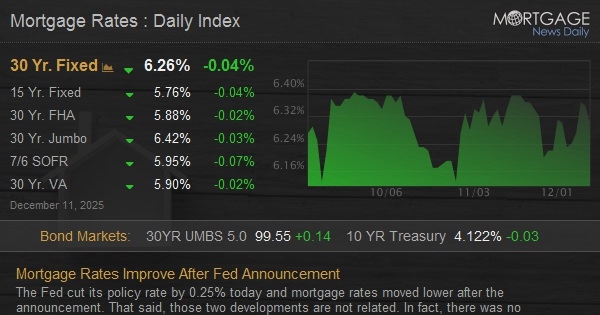
📉 Mortgage Rates as of Today
Here’s where mortgage rates stand right now:
Yes, these rates improved after the Fed meeting. But the cut wasn’t the reason.
🧠 Why Mortgage Rates Went Down (Hint: It Wasn’t the Announcement)
When the Fed cut its policy rate by 0.25%, the bond market—which drives mortgage rates—did not react. Not even a bump.
The real movement came after Fed Chair Jerome Powell spoke in the press conference.
Markets cared more about his message than the cut itself. And here were the key takeaways:
🗝 What Powell Said That Moved the Market
-
“Job gains could have been overstated in recent months.”
This signals a cooling labor market, which reduces inflation pressure—a good sign for mortgage rates.
-
“Growing evidence that inflation is coming down.”
Lower inflation = lower long-term rates.
-
“Rates are now in a high range of neutral.”
This one mattered the most. The “neutral rate” is the range where interest rates neither stimulate nor restrict the economy.
Powell suggesting we’re on the high end implies:
➡️ There may be room for more cuts in 2026.
➡️ The Fed doesn’t see additional tightening ahead.
➡️ Inflation is trending in the right direction.
This is what the bond market wanted to hear.
🏡 What This Means for Buyers and Sellers
For Buyers
Lower mortgage rates improve affordability—and even a small drop can make a real difference in monthly payment. If rates continue to ease into 2026, buyers may find themselves with more buying power than they expected.
For Sellers
Falling rates tend to bring more buyers back into the market. If your home has been sitting or you’ve been waiting for more activity, this shift could help.
📅 What to Expect Moving Forward
Rate projections already anticipated additional cuts in 2026, but hearing Powell confirm the possibility gave the market confidence. If inflation continues on its current path, mortgage rates could gradually trend lower over the next year.
It won’t be a straight line down—but the momentum is shifting in the right direction.
🤝 Want to Know How This Affects Your Situation?
Every household’s numbers are different, and a small rate change may impact your buying or selling strategy more than you think. If you'd like a personalized breakdown of what this means for your next move, our team is here to help.
Texan Heritage Realty Group
Tradition. Integrity. Excellence.
📞 817-776-8319
🌐 www.texanheritage.com
Dec. 11, 2025
If you’ve been watching the housing market and wondering why inventory feels so tight, there’s a simple but powerful reason behind it: the mortgage lock-in effect. It’s shaping buyer behavior, seller decisions, and the overall pace of the market across North Texas and the entire country.
Here’s what it means, why it’s happening, and why this moment may offer more opportunity than people think.
🔒 What Is the Mortgage Lock-In Effect?
In plain English, the lock-in effect is what happens when homeowners are “locked into” ultra-low mortgage rates from the past and are reluctant to give them up.
📉 Here’s the key stat:
About 70% of U.S. homeowners with a mortgage have a rate under 5%,
and
over 80% are under 6%.
That means most people are sitting on a payment they simply can’t replace in today’s rate environment.
So instead of selling and taking on a much higher rate, many stay put. Fewer people list → inventory stays low → prices remain firm.
It’s the same reason I understand the hesitation personally.
My own mortgage rate is 3.15%, and giving that up wouldn’t be fun.
🧩 Why Does This Matter for Buyers?
Because this lock-in effect has kept inventory tight for so long, the buyers who stay engaged in the market actually have more leverage than they realize.
This is the part most people don’t hear:
💬 
“Builders and sellers are more negotiable now than ever.”
Here’s what that looks like in real-world terms:
-
🎯 Builder incentives are back — rate buydowns, closing cost help, upgrade credits.
-
💸 Sellers are more open to price reductions when the home has been sitting.
-
🧾 Repairs and concessions are easier to negotiate than they were during the frenzy of 2020–2022.
-
🏡 New construction is filling the inventory gap and often comes with flexible terms.
For buyers who’ve been waiting for the “right moment,” this season may quietly be one of the best chances to capture value before rates shift again.
🏠 What About Sellers?
If you’re a homeowner wondering, “Should I really give up my 3% or 4% mortgage?”, you’re not alone.
Here’s the truth:
Life events still drive real estate. People upsize, downsize, relocate, divorce, welcome new family members, or change careers. Those needs don’t disappear because rates changed.
If you’re facing a life transition, strategies like rate buydowns, pricing analysis, and equity planning can make your move financially reasonable—even in today’s market.
🤝 Thinking About Buying or Selling?
If you're weighing your options, we’re here to break down your numbers, explore your possibilities, and guide you toward a smart decision that fits your life, not just the market headlines.
Texan Heritage Realty Group
Tradition. Integrity. Excellence.
📞 817-776-8319
🌐 www.texanheritage.com
Dec. 9, 2025
⭐ How to Get Your Home Sale-Ready in North Texas
Maximize your price. Minimize your days on market.
Preparing a home for the market is part art, part strategy, and part good old-fashioned elbow grease. In North Texas — where buyers move quickly and first impressions matter — the homes that sell fastest (and for the strongest prices) usually share the same traits: they’re clean, uncluttered, neutral, well-maintained, and inviting from the curb to the back fence.
If you're planning to sell in Johnson County, Tarrant County, or surrounding areas, here’s a clear roadmap to help you get your home truly sale-ready.
1. Declutter: The Fastest Way to Make Your Home Feel Bigger
Clutter shrinks a room faster than anything else.
Buyers in communities like Cleburne, Burleson, Joshua, and Godley want spaces that feel open, bright, and move-in ready. Aim to remove 30–40% of the items in each room — décor, small furniture pieces, toys, paperwork, excess kitchen items, bathroom products, and more.
Why it matters:
Decluttering makes your home feel larger, cleaner, and more expensive. It also allows your professional photography to shine — which is critical in an online-first real estate market.
2. Deep Clean Like It’s a First Showing Every Day
Buyers equate “clean” with “well taken care of.”
A full deep clean should include:
-
Baseboards
-
Windows
-
Ceiling fans
-
Vents
-
Grout
-
Appliances
-
Floors and carpets
If you have pets, invest in a professional steam clean. It’s worth every penny.
3. Neutral Paint: The Highest ROI Upgrade
One of the most impactful and affordable pre-sale updates is fresh paint in neutral, warm tones. Think soft whites, greige, warm beige, and subtle taupe.
Why? Because buyers across North Texas share one consistent preference:
“I want a home that feels fresh, clean, and move-in ready.”
Neutral paint:
It's inexpensive, but the return is impressive.
4. Light Repairs That Pay Off
Before listing, knock out simple, high-impact fixes:
-
Patch drywall and touch up paint
-
Replace foggy windows
-
Swap outdated light fixtures
-
Repair loose doorknobs or hardware
-
Update yellowed or mismatched light bulbs
-
Replace worn caulking, especially around tubs and counters
-
Address minor plumbing or electrical issues
Buyers notice everything — and small repairs reinforce the story of a well-maintained home.
5. Curb Appeal: Your Home’s “First Impression” Test
In cities like Cleburne, Burleson, Joshua, Weatherford, and Godley, buyers often do a drive-by before scheduling a showing.
Your curb appeal determines whether they even walk through the door.
Simple upgrades:
-
Fresh mulch
-
Trimmed hedges
-
Power-washed sidewalks
-
New welcome mat
-
Seasonal flowers
-
Touch-up exterior paint
A tidy exterior instantly builds trust and signals pride of ownership.
6. Staging: A Proven Way to Boost Your Sales Price
Staging isn’t decorating — it’s strategic storytelling.
Good staging helps buyers imagine their life in the home, not yours. It highlights your home’s strongest features and guides the eye through each room.
Top staging wins:
-
Light, simple décor
-
Symmetrical bedding in the primary bedroom
-
Clean countertops
-
Neutral artwork
-
Defined spaces (office, dining, living)
-
Fewer, larger furniture pieces instead of many small ones
Professional staging consistently increases both online engagement and final sales price.
7. Prepare for Photography: Your Home’s Online Debut
Most buyers in North Texas make their short list online.
Before photos:
Your photos should tell a story of light, space, and simplicity.
8. Work With a Real Estate Team That Knows What Sells
Homes in our area sell fastest — and for the highest return — when sellers have a clear plan.
At Texan Heritage Realty Group, we walk you through:
Your goal is simple: maximize your price and minimize your days on market — and we're here to make that process smooth.
📞 Ready to Get Your Home Sale-Ready?
We’d love to walk your property and give you a customized, no-obligation preparation plan.
Call or text us anytime at 817-776-8319
Visit TexanHeritage.com
Serving Johnson County, Tarrant County, Hood County, Parker County, and surrounding areas.
Dec. 9, 2025
Fannie Mae Just Made It Easier to Qualify for a Home Loan — Here’s What You Need to Know
For years, many hopeful homebuyers have been stopped in their tracks by one number: 620.
That’s been the minimum credit score required for conventional loans backed by Fannie Mae — until now.
As of November 16, 2025, Fannie Mae is removing that hard 620 credit score cutoff for loans run through Desktop Underwriter (DU), their automated approval system. This update means buyers with lower or limited credit scores may now qualify for a conventional loan based on their overall financial picture, not just one number on a report.
What’s Changing — and Why It Matters
Instead of relying on a fixed minimum score, Fannie Mae’s DU system will now use a comprehensive risk-based model that evaluates the full profile of a borrower.
That means your approval could hinge on things like:
-
Stable employment and consistent income
-
Manageable debt-to-income ratio
-
Cash reserves and down payment
-
History of on-time payments
-
Strength of the property and loan terms
If your credit score has held you back — maybe you’re rebuilding credit, or your file is “thin” because you haven’t used much credit — this change could open a real door.
Who Could Benefit
-
Buyers with scores below 620 who previously didn’t meet conventional loan guidelines.
-
First-time buyers with limited credit history or non-traditional tradelines (like rent or utility payments).
-
Borrowers recovering from past credit issues but with strong recent financial behavior.
-
Clients comparing FHA vs. conventional — this change could make a Fannie Mae-backed loan possible with better long-term flexibility.
It’s worth noting: lenders may still apply their own overlays or pricing adjustments, and credit scores will still influence rates. But this update gives qualified buyers more paths to approval than ever before.
What It Means for North Texas Buyers
In a market like Johnson County and the Greater Fort Worth area, where affordability and opportunity meet, every advantage counts.
For families who’ve worked hard to build stability — but whose credit score hasn’t quite caught up — this could be the chance to get approved for a conventional mortgage instead of waiting months or choosing a higher-cost option.
Our Take at Texan Heritage Realty Group
At Texan Heritage Realty Group, we believe every buyer deserves an honest path to homeownership — one rooted in tradition, integrity, and excellence.
Our team works side-by-side with trusted local lenders who stay ahead of these updates, so we can help you explore every possible option to get you home.
Have Questions About How This Affects You?
Give our team a call at 817-776-8319 or visit TexanHeritage.com to schedule a free consultation.
Whether you’re buying your first home or getting back into the market, we’ll help you understand your options and connect you with lenders who can make the most of this new opportunity.
Because at Texan Heritage Realty Group — we don’t just practice real estate the best we can; we practice real estate the best it can be done.
Dec. 5, 2025
How Much House Can You Really Afford in North Texas?

Your guide to setting a smart, realistic home-buying budget
Buying a home is exciting. It’s hopeful. It’s a little intimidating. And before most buyers ever step into an open house, they’re asking the same question: “What can I actually afford?”
It’s a fair question — especially in a market like ours, where interest rates shift, property taxes vary widely, and neighborhoods from Fort Worth to Cleburne, Joshua, Burleson, Granbury, and Godley all come with their own price rhythms.
Here’s a clear, grounded guide to building a real budget you can trust.
Start with the Rule of the Real World: Your Monthly Payment Matters More Than the Price Tag
Most lenders will approve you based on a debt-to-income ratio (DTI).
Most buyers, though, should approve themselves based on monthly comfort.
A house priced at $350,000 can feel affordable at one rate and completely out of reach at another. Instead of asking “How much house can I buy?” shift to:
“What monthly payment keeps my life comfortable?”
For most North Texas buyers, that number sits in a range where your mortgage + taxes + insurance + HOA (if applicable) fits into 25–33% of your monthly take-home.
Break Down the Four Pieces of a Mortgage Payment
1. Principal & Interest
This is the part tied tightly to interest rates — and it’s why the same buyer can afford $25–$75k more or less depending on the day they lock their loan.
2. Property Taxes
Texas doesn’t have a state income tax, so property taxes do plenty of heavy lifting.
Johnson, Tarrant, Parker, and Hood can all vary — sometimes by thousands per year — and that impacts affordability more than most people think.
3. Homeowners Insurance
Prices have climbed statewide, especially with recent storms, roof claims, and cost of materials.
4. Mortgage Insurance (if putting less than 20% down)
FHA, USDA, VA, and conventional loans all have different rules here. It’s not a bad thing — but it belongs in the budget.
Why a Lender Pre-Approval Makes All the Difference
Online calculators are a decent starting point.
But a lender’s pre-approval tells you what you can qualify for — and more importantly, what you should aim for.
A great lender considers:
-
Rising or falling interest rates
-
Your income history
-
Your credit profile
-
Loan programs you may qualify for (FHA, VA, USDA, down-payment assistance)
-
True monthly affordability
-
Long-term goals, not just short-term approvals
A lender who only tells you the maximum you can qualify for isn’t doing you any favors. You deserve a budget tailored to your life, not a one-size-fits-all number.
Run “Life Tests,” Not Just Math Tests
Before committing, ask yourself:
-
Could I still breathe easy if the AC goes out in July?
-
Do I want to travel, save, invest, or stay flexible?
-
Do I feel stretched or steady at this payment?
Affordability isn’t only about math — it’s about lifestyle and peace of mind.
North Texas Example: What Buyers Are Actually Qualifying For Right Now
These numbers shift with rates, but here’s a typical snapshot we’re seeing:
-
A buyer making $85k/year with average debts often qualifies somewhere between $300k–$375k.
-
A buyer making $120k/year might qualify between $425k–$525k.
-
A buyer with minimal monthly debts can often afford much more than they expect.
-
A buyer with car loans or student loans may need a bit more strategy — but they’re absolutely still in the game.
Every buyer’s situation is unique, but these ranges give many people a solid starting point.
The Bottom Line
You don’t need to guess.
You don’t need to browse homes that are too high or too low.
And you definitely don’t need to feel overwhelmed.
When you understand your monthly comfort level, know how taxes and insurance affect things, and get a strong pre-approval, you’ll walk into the home-buying process with clarity — and confidence.
Ready to Start Your Home Search With a Real Budget?
Our team helps buyers across Johnson County, Tarrant County, and surrounding areas figure out exactly what they can afford — without pressure, without confusion, and without surprises.
Whether you’re buying in Cleburne, Burleson, Fort Worth, Joshua, Godley, or Granbury, we’d be honored to guide you.
📞 Call or text Texan Heritage Realty Group at 817-776-8319
🌐 Start your search at TexanHeritage.com
